Luxeuil Abbey, Benedictine monastery in Luxeuil-les-Bains, France.
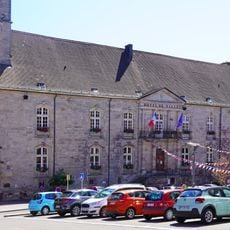
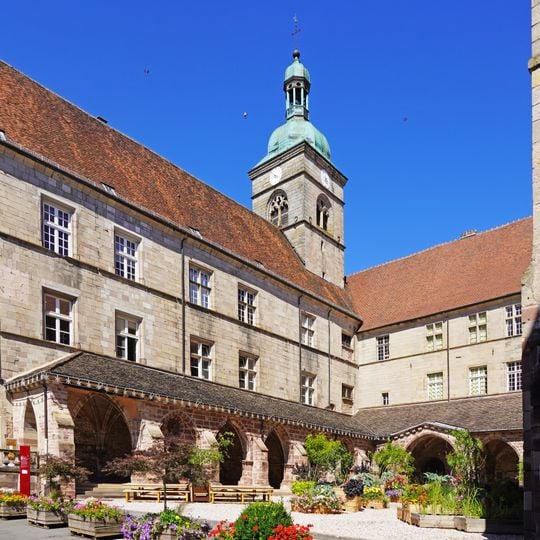
Luxeuil Abbey, dedicated to Saints Peter and Paul, consists of a 14th-century Gothic church and Baroque conventual buildings of light beige stone with steep red-tiled roofs. A square tower capped by a green copper dome with a lantern and cross rises at one end, and a pointed-arch arcade runs along the base. The church, now the Basilica of Saint-Pierre, serves as the parish church.
Founded around 590 by the Irish monk Columbanus on the overgrown ruins of the Roman town Luxovium, the abbey was built with a grant from a palace officer at Childebert's court. Under abbots Eustace and Waldebert (629–670) its school, library and scriptorium gained renown, and monks went out to found Bobbio, Remiremont and Corbie. Sacked by the Saracens around 732, it was restored by Charlemagne and Louis the Pious, who appointed Ansegis abbot in 817.
The abbey's scriptorium is first documented under Abbot Waldebert (629–670), and around 670 minuscule script was probably used there for the first time. The best-known product is the Lectionary of Luxeuil, found at Luxeuil by Jean Mabillon and now kept at the Bibliothèque nationale de France in Paris (Lat. 9427), not on site.
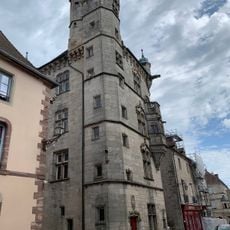
The former abbey church, now the parish church of Saint-Pierre, stands in the town centre; the surviving cloisters and conventual buildings adjoin it. The site is a classified historical monument, and the buildings that once served as a diocesan seminary are not freely open, so visits depend on the church's opening and on guided tours.
The Lectionary of Luxeuil, copied around 670, was probably the first manuscript to use minuscule script. Jean Mabillon found it at Luxeuil; it is now kept at the Bibliothèque nationale de France in Paris (Lat. 9427), not in the abbey.
The community of curious travelers
AroundUs brings together thousands of curated places, local tips, and hidden gems, enriched daily by 93,933 contributors worldwide.