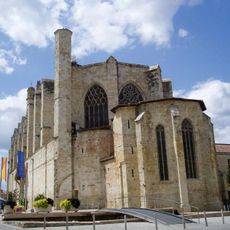
Flaran Abbey, Cistercian monastery in Valence-sur-Baïse, France.
Flaran Abbey is a former Cistercian monastery in Valence-sur-Baïse, founded in 1151 at the confluence of the Auloue and Baïse rivers. Its Romanesque church has a steep gabled facade with a round oculus window and three narrow arched windows. The vaulted chapter house, with pointed arches and ribbed vaulting on cylindrical columns with carved capitals, is among the best-preserved monastic rooms in south-west France.
Founded in 1151 as a daughter house of Escaladieu Abbey, Flaran received papal confirmation of its lands in 1162 and 1187. In 1569 troops of Montgomery burned the church and cloister and destroyed the archives. The abbey was sold as national property in 1792 and later became a farm, with the chapter house used to store grain.
The abbey holds a permanent exhibition on the routes to Santiago de Compostela through the Gers, the only permanent display on this theme in the former Midi-Pyrénées region, and since 2005 another on its own history. Since 2004 it has shown drawings, paintings and sculptures from the 16th to 21st centuries deposited by the Simonow collection.
The site is entered through a wrought-iron gate before the gabled Romanesque facade; the chapter house, with its three cylindrical columns and ribbed vaults, is reached from the cloister. The grounds are flat and walked on foot, with pale gravel underfoot in the vaulted rooms. The abbey lies between Condom and Auch, at the confluence of the Auloue and Baïse, near Valence-sur-Baïse.
A local archaeological society prevented parts of the monastery from being moved to a New York museum in 1913. This decision allowed the complex to remain intact at its original location for visitors to explore today.
The community of curious travelers
AroundUs brings together thousands of curated places, local tips, and hidden gems, enriched daily by 93,608 contributors worldwide.