Tumulus of Bougon, Prehistoric burial mound in Bougon, France
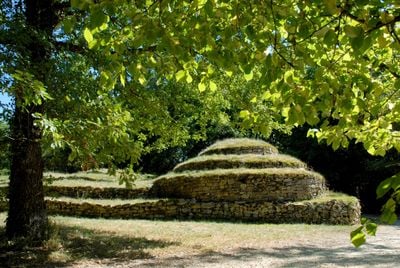
The Tumulus of Bougon is a prehistoric burial site containing five large earthen mounds with different internal structures. Each mound holds burial chambers and passageways designed to hold the dead.
The oldest structures, E1 and F0, date to 4800 BC; the site was used until the mid-3rd millennium BC. Discovered in 1840 by Charles Arnault, it was bought by the Deux-Sèvres department from 1874 to 1879 and classified as a monument historique on 8 February 1960. Excavations resumed in 1968 under Claude Burnez, then from 1972 to 1986 under Jean-Pierre Mohen.
The site reveals how Neolithic communities honored their dead and what objects held meaning for them. The remains and artifacts found here show the spiritual beliefs and daily practices of people living thousands of years ago.
The five mounds and the dry-stone wall D stand within a fenced archaeological park on the limestone plateau in the Bougon river loop. The on-site Musée des Tumulus, built by the Deux-Sèvres department, holds finds from the regional excavations. Paths cross uneven grass, so wear sturdy shoes; the chambers are entered through low passages.
The 90-ton capstone of Tumulus A rests on two central pillars set at a 15° angle as buttresses to spread its weight. Most of the other uprights still carry small packing stones on top, placed there to level the slab. The central pillar bears a fine engraving read as a bird, noted as early as 1840, and shows ammonite fossils.
The community of curious travelers
AroundUs brings together thousands of curated places, local tips, and hidden gems, enriched daily by 94,384 contributors worldwide.