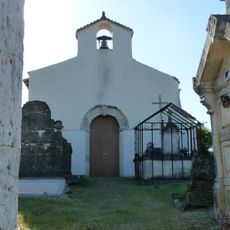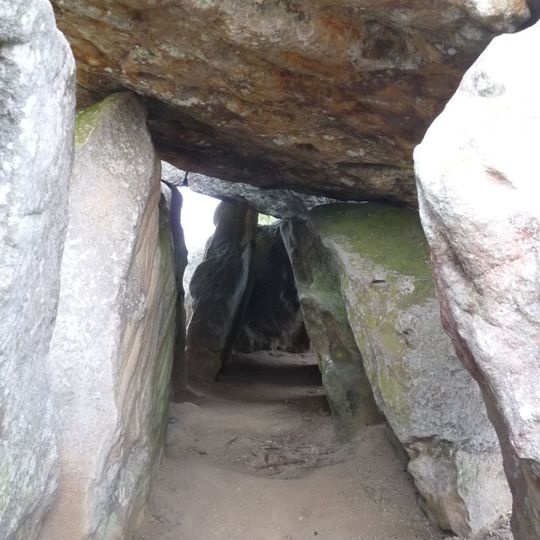
Dolmen de Pierre Folle, Archaeological site and dolmen in Montguyon, France.
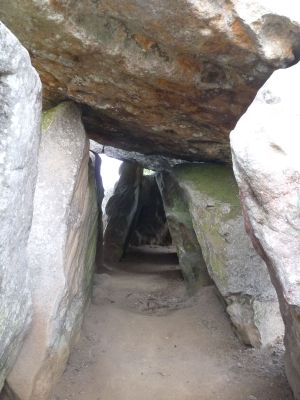
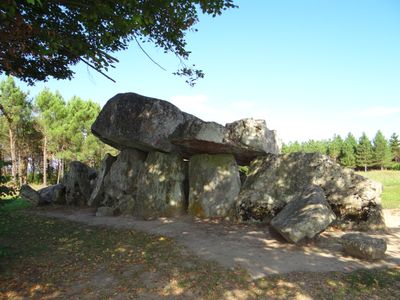
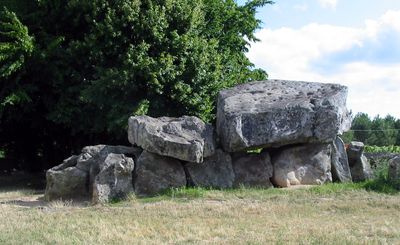
The Dolmen de Pierre Folle is a megalithic complex of local sandstone measuring 16 m long, 3 m wide and up to 4 m high, made of a ruined Angoumoisin-type dolmen and an Aquitain-type covered passage. The passage, 9.50 m long and 1 m wide, has nine orthostats decreasing in height toward the entrance and two remaining capstones, the largest 1.40 m thick and about 30 t. A third capstone lies overturned outside.
The covered passage was built around 3500 BCE in the regional Middle Neolithic, possibly by the Roquefort group, while the Angoumoisin-type dolmen predates it by at least 500 years. Louis-Benjamin Fleuriau de Bellevue saved the monument from destruction, and it was classified as a historical monument in 1889. Camille Duteil excavated it in 1840, followed by Gassier and François Daleau in 1874.
Local legend holds that the monument turns three times on itself at midnight on Christmas Eve. Another tradition says the stones fell from the sky and were assembled by the Virgin Mary, while a third credits Charlemagne with building it to bombard Montlieu.
The monument stands in woodland north of Montguyon, reached on foot; no private parking is provided at the stones. The covered passage is low and narrow, about 1 m wide, and its floor rises toward the back, so watch your footing on the packed earth. The overturned third capstone lies outside the passage and can be seen from the path.
The largest stone of the structure weighs around 30 tons and forms part of the roof system. This massive stone was moved into place without any modern machinery.
The community of curious travelers
AroundUs brings together thousands of curated places, local tips, and hidden gems, enriched daily by 94,018 contributors worldwide.