Château de Vaussieux, 18th-century castle in Vaux-sur-Seulles, France.
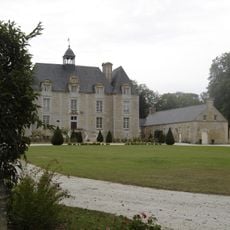
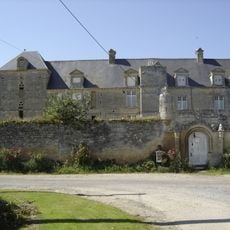
Château de Vaussieux is a three-storey stone building with a grey slate hipped roof, built in the second half of the 18th century. Its symmetrical facade has a central projecting bay with a stone balustrade balcony above the entrance, and white-shuttered windows. The central bay is crowned by a triangular pediment, and the building stands behind a gravel drive bordered by lawn.
Vaussieux belonged to a family of that name by 1056, when Hugon de Vaussieux is recorded. In 1413 Catherine de La Luzerne sold the seigneurie, which passed by marriage to the Grimouville family and in 1605 to the de Thioult family. Jacques de Thioult built a new château in 1637; in 1771 the Marquis d'Héricy replaced it with the present building, which in August 1778 became Marshal de Broglie's headquarters for the camp de Vaussieux.
The central pediment of the courtyard facade carries the arms of the Marquis and Marquise d'Héricy, who rebuilt the château in 1771. Inside, the dining room has Corinthian pilasters on a dark marble base and a stucco arabesque frieze. A fountain with a bronze bathing woman, a copy after Étienne-Maurice Falconet, stands in a niche lined with pink marble and framed in violet marble.
The château stands in Vaux-sur-Seulles, reached by a gravel drive off the local road; an iron gate on the south side opens onto a forecourt with a stone balustrade. From there a straight path of about 80 metres leads to the central pavilion. The grounds are private and the building is not open to the public, so visits are limited to the exterior and the surrounding lanes.
In 1771, Philippe Jacques d'Héricy commissioned a transformation of the building by adding an extra floor. This change was meant to increase natural light inside and shows the attention given to living comfort during that era.
The community of curious travelers
AroundUs brings together thousands of curated places, local tips, and hidden gems, enriched daily by 93,485 contributors worldwide.