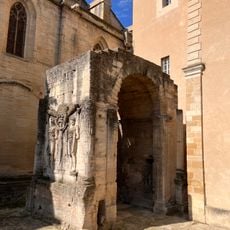
Holy Bridle, Sacred relic in Carpentras Cathedral, France.
The Holy Bridle is a gilded bronze reliquary made in 1872 by Lyon silversmith Thomas Joseph Armand-Calliat, replacing a 1330 vermeil shrine destroyed during the French Revolution. Its circular foot is decorated with four horses, and the central custode, set on a white-and-red damask ground studded with gold nails, is framed by scrollwork and four six-winged cherubim. The bridle itself, weighing 350 g, has 17 cm canons and 160 mm branches.
The original materials of this relic were said to have been discovered by Helena, mother of Emperor Constantine, during her time in Jerusalem. This finding in the early 300s influenced how churches across Christianity handled sacred objects.
The bridle became Carpentras's emblem in 1260, shown as a silver bit on a red field. On 27 November, the feast of Saint Siffrein, the relic is presented to the faithful in the Chapelle du Saint Clou. The 1872 reliquary by Lyon goldsmith Thomas Joseph Armand-Calliat bears an inscription from Zechariah: "In die illa erit, quod super frenum equi sanctum domino omnipotenti."
The bridle is kept in the Chapelle du Saint Clou of Carpentras Cathedral, not in a separate treasury room. It is shown to the faithful each year on 27 November, the feast of Saint Siffrein, so that date is the surest time to see it. Outside that occasion, ask at the cathedral about access to the chapel.
The bridle is said to contain metal from the actual nails used during the crucifixion. This direct connection to a central event of Christianity made such objects extraordinarily precious to medieval believers.
The community of curious travelers
AroundUs brings together thousands of curated places, local tips, and hidden gems, enriched daily by 93,465 contributors worldwide.