Maison des Fées, Passage grave in Mesnil-Roc'h, France.
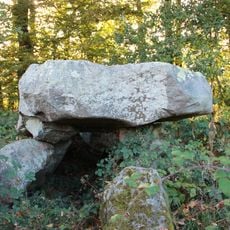
The Maison des Fées is a covered passage (allée couverte) in the Forêt du Mesnil at Tressé, 12 m long and 1.20 m wide, bounded by nineteen orthostats and an end slab. Eight covering slabs rest on the uprights, and a small uncovered antechamber sits at one end. The structure is oriented north-northwest to south-southeast.
The passage grave was classified as a monument historique in 1889. In 1929 the owner, Baron Surcouf, asked the English archaeologist Robert Mond to excavate it; Mond dug in 1931 and restored the monument. His assistant V.C.C. Collum published the finds: a skeleton, pottery, a steatite bead necklace, a bronze as of Domitian and two iron fragments.
The name "Maison des Fées" (fairies' house) comes from a Breton legend: the fairies living in the monument let a cow escape into a neighbour's field, and paid the farmer with a piece of bread that would neither harden nor shrink as long as he kept its origin secret. He eventually confessed, and the bread turned too hard to eat. In Breton the monument is called ti ar boudiged.
The monument lies in the Forêt du Mesnil, east of Le Bourg in Tressé, on the edge of an oak wood; the passage is oriented north-northwest to south-southeast. The chamber is 12 m long and 1.20 m wide, so entry is low and the floor is bare earth. Look for the small uncovered antechamber at the end.
On the right inner side slab, two pairs of breasts are carved in relief, each with a necklace below; the outer headstone carries a similar pair, mutilated in the 1980s. The motif, read as a mother goddess of fertility and death, recurs at Kerguntuil and Prajou-Menhir.
The community of curious travelers
AroundUs brings together thousands of curated places, local tips, and hidden gems, enriched daily by 94,178 contributors worldwide.