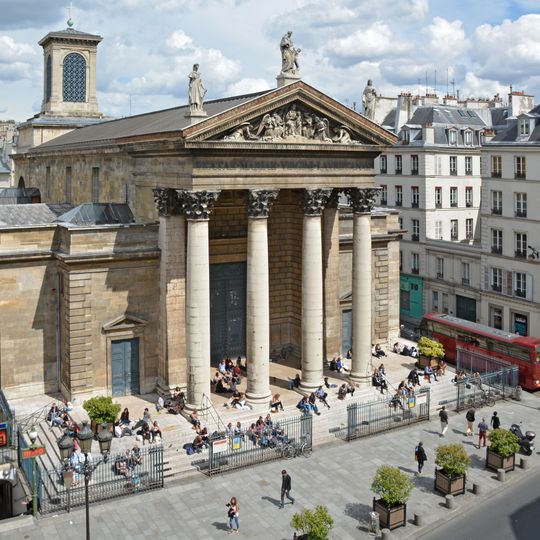
Notre-Dame-de-Lorette, Neoclassical church in 9th arrondissement, France.
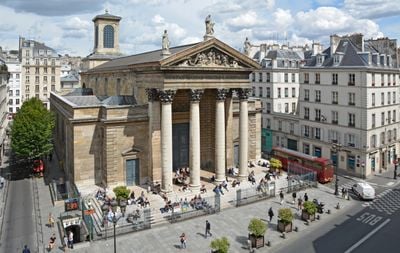
Notre-Dame-de-Lorette is a Neoclassical church built from 1823 to 1836 by Louis-Hippolyte Lebas. Its pale limestone facade has a portico of six Corinthian columns, a pediment with Charles-François Nanteuil's sculpture of angels adoring the Virgin and Child, and three statues of Faith, Hope and Charity by Charles-René Laitié. The interior is a basilical nave without a visible transept, with a flat coffered ceiling of gilded wood by Hubert-Nicolas Lamontagne and columns separating the aisles.
Architect Hippolyte Le Bas built this church between 1823 and 1836, solving foundation challenges by constructing it on stilts. This engineering approach reflects how Parisian builders overcame difficult soil conditions.
In the 1840s the church's name gave rise to the term "Lorette", used in newspapers, songs and novels for women of loose morals who lived in buildings near the church. The neighbourhood is also called the New Athens, after the many artists and writers, including George Sand, Renoir and Alexandre Dumas, who settled there in the 19th century.
The church sits at the corner of Rue de Châteaudun and Rue Saint-Lazare, with the Notre-Dame-de-Lorette metro station providing direct access. The location is central and easy to reach, surrounded by shops and cafés in a lively neighborhood.
The church's name gave rise in the 1840s to the word "lorette", used in newspapers, songs and novels for women of loose morals, because many prostitutes lived in the buildings around it. The painter Claude Monet was also baptised here, on 20 May 1841.
The community of curious travelers
AroundUs brings together thousands of curated places, local tips, and hidden gems, enriched daily by 93,464 contributors worldwide.