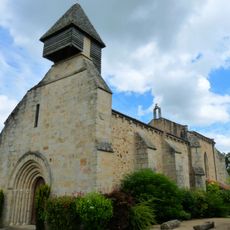
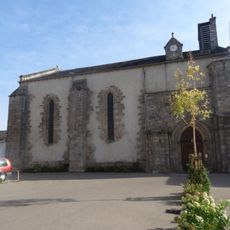
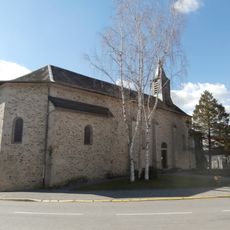
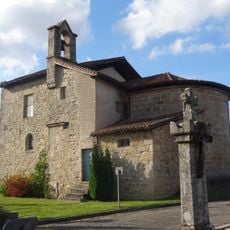
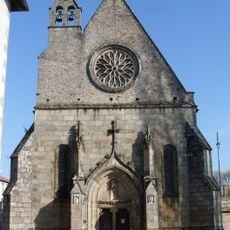
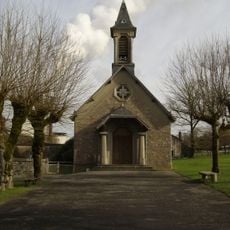
Collégiale Saint-Junien, Romanesque church in Saint-Junien, France.
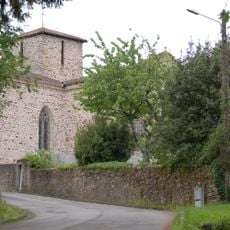
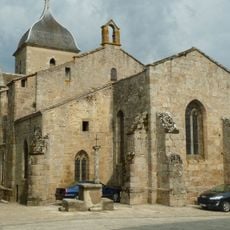
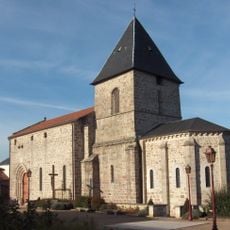
Collégiale Saint-Junien is a Romanesque church built of light tan stone blocks, with a three-aisled nave, a transept extending beyond the outer walls, and a three-tower westwork. A slender cylindrical tower with a conical roof and a square tower with a pyramidal roof rise above the roofline. The nave and transept retain 11th- and 12th-century frescoes, including the 24 elders of the Apocalypse.
A first church was begun in 544 over the tomb of the hermit Junien, and Gregory of Tours noted the pilgrimage there in 593. After collapse in the 9th century, canons rebuilt from the early 1090s under provost Israel; the church was consecrated on 21 October 1100 by Raynaud, Bishop of Périgueux. Construction continued to the mid-13th century, funded by pilgrims on the Via Lemovicensis.
The carved capitals inside show griffins, centaurs, and other mythical creatures that reflect Oriental influences. These sculptures reveal how far artistic connections reached during the Middle Ages.
Take time to examine the carved capitals and the restored frescoes on the walls as you walk through the space. The light inside changes throughout the day, so the colors appear different depending on when you visit.
The 12th-century tomb of Saint Junien is carved from limestone, not marble or metal. Canon Étienne Maleu, who wrote the history of the chapter, was buried in the collegiate church; the central bell tower collapsed in 1922 and was rebuilt.
The community of curious travelers
AroundUs brings together thousands of curated places, local tips, and hidden gems, enriched daily by 93,942 contributors worldwide.