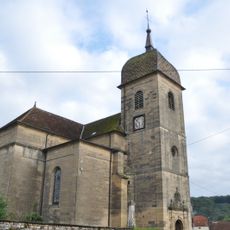
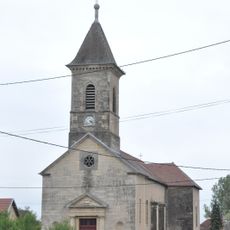
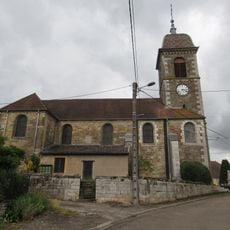
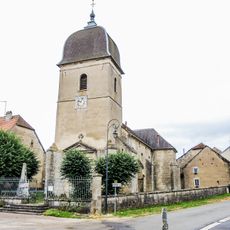
Abbaye de Cherlieu, Romanesque abbey in Montigny-lès-Cherlieu, France.
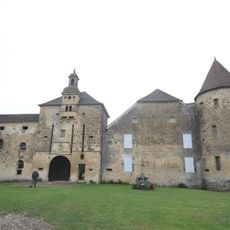
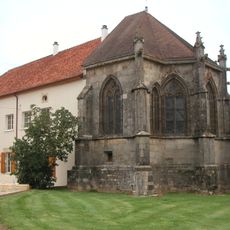
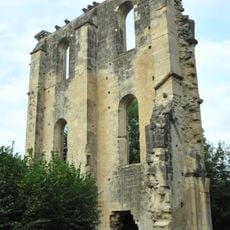
Abbaye de Cherlieu is a ruined Cistercian monastery in the Forest of Cherlieu, within Montigny-lès-Cherlieu. The surviving north transept wall of the church, built between 1150 and 1220, shows three arched windows above two lower arched openings, divided by tall buttresses, with jagged masonry at its right edge. Nearby stand the roofless 17th- and 18th-century kitchen and refectory, and remnants of the 15th-century cloister.
Founded in 1131 by monks from Clairvaux under Guy, its first abbot, Cherlieu became mother house of Acey (1136), Le Gard (1137), Hauterive (1132) and Haut-Crêt (1143). The Écorcheurs attacked it in 1437-1439 and Protestants burned it in 1569. Rebuilt under Abbot Ferdinand de Rye, it was suppressed in 1790 and used as a stone quarry.
The Latin name Carus locus, "dear place", gave Cherlieu; the abbey was mother house of Hauterive and Haut-Crêt in Switzerland and of Acey, Le Gard and Beaulieu-en-Bassigny. Its church, 105 m long with a 22 m vault, served as a model for Langres Cathedral. In 1309 Othon IV and his brother Jean de Bourgogne were buried here before 1,500 people.
The ruins stand in the Forest of Cherlieu, about 6 km south-east of Vitrey-sur-Sance and 37 km west-north-west of Vesoul. The church floor lies buried under a layer of debris, so the surviving north transept wall is best seen from outside. The kitchen and refectory of the 17th and 18th centuries stand roofless, and the 15th-century cloister arcades are fragmentary.
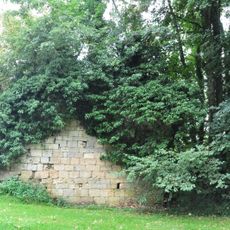
After the monastery was dissolved during the French Revolution, its stone structure was partially dismantled and the materials were reused to build houses throughout the region. This explains why the remains appear fragmented today and why many local buildings contain stones salvaged from this site.
The community of curious travelers
AroundUs brings together thousands of curated places, local tips, and hidden gems, enriched daily by 94,600 contributors worldwide.