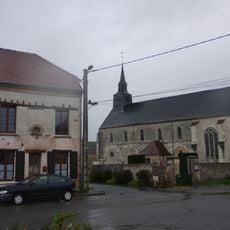
Château d'Armentières, Medieval castle in Armentières-sur-Ourcq, France.
Château d'Armentières is a ruined stronghold of pale beige stone rising behind a field. On the left, a round tower with a steep reddish-brown conical roof has narrow window openings; to its right stand jagged, roofless wall fragments and a taller tower-like section with a pointed gable outline. Further right are a squarer building with a pitched red roof and a flat-topped tower, and a low red-roofed wall at the far right.
A knightly lineage held a stronghold at Armentières from the second half of the 12th century; Gui d'Armentières is the first known lord. The present ruins date from a house fortified in the late 13th or early 14th century, sold in 1446 to Jean II Jouvenel des Ursins, bishop of Laon. Gilles Juvénal des Ursins probably modernised the residence in the 1560s, and the site was classified as a historical monument in 1921.
The castle's name comes from the Armentières lineage, whose first known lord, Gui, held a stronghold here in the second half of the 12th century. In 1197 he founded a wine-growing settlement on his land at a spot called la Haie. The seigneurie later passed by marriage to the Conflans family, then in 1446 to Jean II Jouvenel des Ursins, bishop of Laon.
Access to the ruins requires caution as parts are damaged and structurally unstable in places. Wear sturdy footwear and expect that certain areas may be restricted or difficult to navigate.
The seigneurie was split between two branches of the Armentières lineage, each holding its own maison-forte; a 1275 fief census lists both houses in the same hands. Jean II de Conflans bought back Henri d'Armentières's share in 1394, reuniting the lordship. The ruins have been a protected monument since 1921.
The community of curious travelers
AroundUs brings together thousands of curated places, local tips, and hidden gems, enriched daily by 94,399 contributors worldwide.