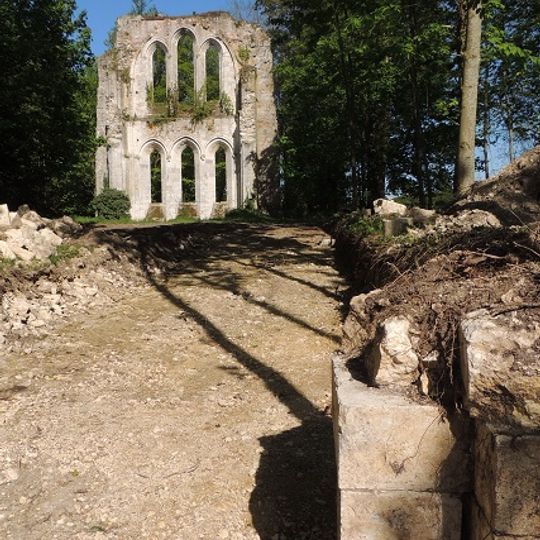
Jouy Abbey, Romanesque abbey ruins in Chenoise-Cucharmoy, France
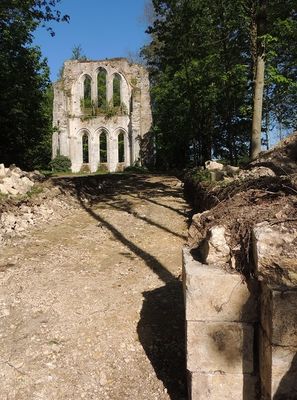
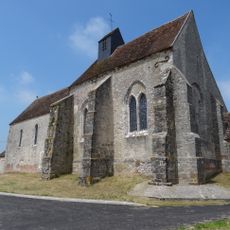
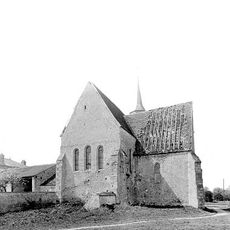
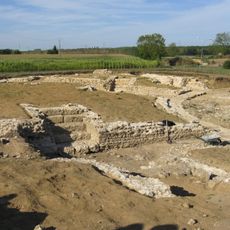
Jouy Abbey is a Cistercian ruin in Chenoise-Cucharmoy, Île-de-France, at the edge of the Forêt de Jouy. The surviving church chevet is a flat wall of pale stone with two tiers of tall openings: three round-headed arches below, their upper parts filled, and three open pointed Gothic arches above, rising to a jagged top. A gravel path leads to it.
Founded in 1124 by Thibaut II of Champagne on land given by Pierre du Châtel and Milon de Naud, Jouy was the fourth daughter house of Pontigny Abbey. It founded four abbeys of its own: Bonlieu (1141), La Noë (1144), Pontaut (1151) and Sellières (1168). The church was completed in 1224, and the abbey was dissolved and sold as national property during the French Revolution.
The abbey's name survives in Paris: from 1297 to 1479 it held a dependency in today's 4th arrondissement, and the rue de Jouy is named after it, the monastic property covering what are now numbers 13 to 17. Cistercian austerity long banned statues, but by the 14th century the rule was relaxed and Jouy owned a seated Virgin and Child.
The ruins lie in a remote rural setting surrounded by farmland and are located on private property, limiting public access. Before planning a visit, check local tourism information to understand current conditions and whether viewing is possible.
From 1297 to 1479 the abbey held a dependency in what is now the 4th arrondissement of Paris; the rue de Jouy takes its name from it, and the monastic property covered today's numbers 13 to 17. The church also held the enamelled and hammered copper tomb of Simon de Beaulieu, Archbishop of Bourges, drawn by François Roger de Gaignières.
The community of curious travelers
AroundUs brings together thousands of curated places, local tips, and hidden gems, enriched daily by 95,456 contributors worldwide.