Rangen, Grand Cru vineyard in Thann and Vieux-Thann, France.
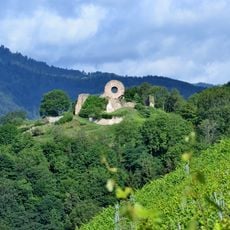
Rangen is a Grand Cru vineyard in Thann, in the Alsace region of France, planted on steep volcanic slopes above the Thur river. The dark rock beneath the vines absorbs heat from the sun and keeps the grapes warm even when the surrounding air cools down.
The Rangen is documented from the 13th century: in 1291 the Dominicans of Basel bought four scadi (sixteen hectares) of vines there, and in 1292 the abbey of Masevaux, the convent of Einsiedeln and the Cistercian abbey of Haute-Seille became owners. In 1548 and 1581 decrees of the town of Thann banned non-noble grape varieties, and the wine was known as far as Vienna under Maria Theresa. After phylloxera and the industrial revolution the steep plots were abandoned; only 5 hectares were still worked in 1966, and Léonard Humbrecht helped revive the slope before it was classified Grand Cru on 23 November 1983.
The name Rangen is traced either to an Old German word for a very steep slope or to Ranke, the vine tendril. Pilgrims heading to the St. Theobald church in Thann spread the wine's fame, and writers from Sebastian Brant to Montaigne mentioned it. A curse, "May the Rang strike you!", was already popular across Germany in the 16th century.
Sturdy shoes are important because the paths along the slopes are steep and become slippery after rain. Walking from the bottom upward gives a good sense of the full height of the vineyard and how the land is arranged.
The Rangen is the only Alsace Grand Cru on volcanic soil, a mix of alkaline lava, ash and tuff. Its hard, dark greywacke in the lower part of the slope stores the sun's heat, and the incline of up to 68 degrees lets the light strike almost vertically. The site also records around 1,000 mm of rain a year, more than the rest of the Alsace vineyard.
The community of curious travelers
AroundUs brings together thousands of curated places, local tips, and hidden gems, enriched daily by 93,844 contributors worldwide.