Saint-Pierre de Montmartre, Romanesque church on the Montmartre butte, Paris, France
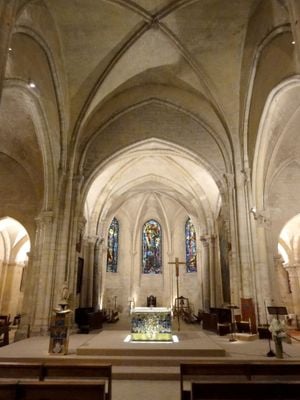
Saint-Pierre de Montmartre is a Romanesque church whose nave, flanked by lower side aisles, dates to the 12th century; its pentagonal apse was rebuilt at the end of that century. The double arch separating choir from apse rests on two ancient marble columns with Merovingian capitals. In the right aisle, a 12th-century capital shows a man with a pig's head riding a man with a goat's head, figures of Luxury and Sorcery.
Construction began in 1133 under King Louis VI as part of the Montmartre Abbey complex. The builders reused materials from an earlier Merovingian basilica that had been dedicated to Saint Denis.
The church kept two functions after 1133: the eastern part, dedicated to the Virgin and Saint Denis, belonged to the Benedictine nuns of the royal abbey, while the western part, dedicated to Saint Peter, served the parish. In the 1670s and 1680s, while Marguerite Louise d'Orléans, Grand Duchess of Tuscany, lived in confinement at the abbey, Marc-Antoine Charpentier wrote devotional music performed there.
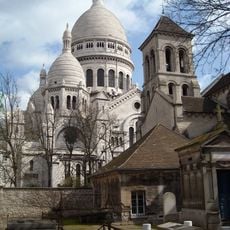
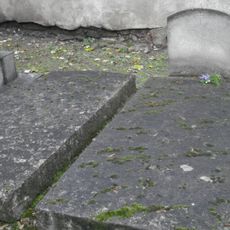
The entrance sits behind a tree-filled courtyard off rue du Mont-Cenis, west of the Sacré-Cœur. A gateway from the parvis leads to the Cemetery of Calvary, the old parish graveyard, which opens only on 1 November, All Saints' Day. The facade dates from 1775 and carries three cast bronze doorways made in 1980 by Tommaso Gismondi.
The four dark marble columns in the choir's double arch come from a Roman temple, and their white capitals were carved in the Merovingian period, in the 6th or 7th century. A sixth Merovingian capital was found in the south aisle wall at the start of the 20th century.
The community of curious travelers
AroundUs brings together thousands of curated places, local tips, and hidden gems, enriched daily by 94,387 contributors worldwide.