Villers–Bretonneux Australian National Memorial, War memorial in Fouilloy, France
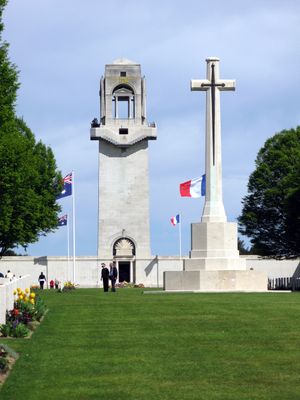
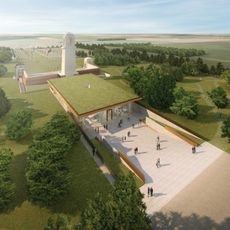
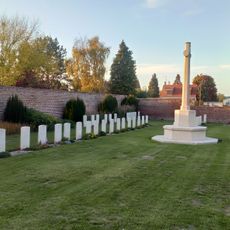
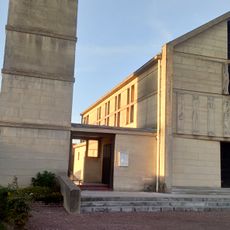
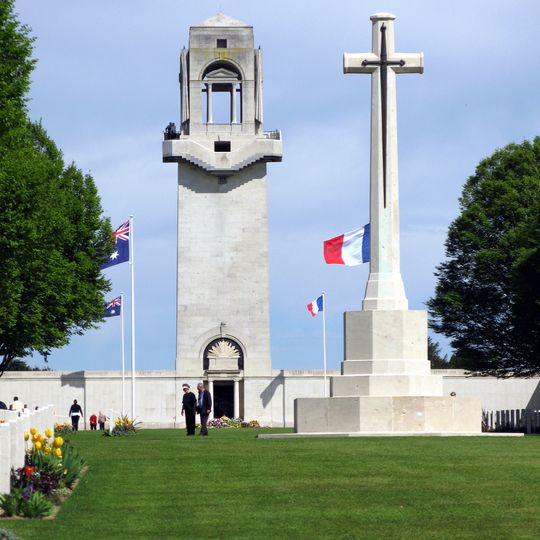
The Villers-Bretonneux Australian National Memorial stands on the D23 road between Fouilloy and Villers-Bretonneux. It is built of pale stone: a square tower with an open arched belfry, a projecting balcony and a shallow pyramidal roof bearing a small cross, with an arched entrance flanked by two standing figures. To its right rises a large Latin cross on a stepped base. Walls and panels link two white stone pavilions and carry the names of 10,773 missing Australian soldiers.
Lieutenant General Sir Talbot Hobbs chose the site after World War I to mark the Australian role in the Second Battle of Villers-Bretonneux (24–27 April 1918). A 1925 competition open to Australian veterans and parents, requiring Australian stone, was won by William Lucas, but the project was suspended in 1930. A cheaper design in French stone by Sir Edwin Lutyens was built in 1936–1937 and unveiled on 22 July 1938 by King George VI, broadcast live to Australia.
Each 25 April, an Anzac Day Dawn Service begins at 5.30am, organised by the Australian Department of Veterans' Affairs, followed by community services in Villers-Bretonneux and Bullecourt. Visitors place paper or cloth poppies beside engraved names or at the foot of the memorial. The Franco-Australian Museum, founded in 1975, occupies the first floor of the Victoria school in the town.
You can climb the tower for views across the surrounding former battlefields and countryside. Wear sturdy shoes as the steps are steep and the paths around the grounds may be uneven.
The memorial and the cemetery's Cross of Sacrifice still carry impact marks from the fighting of the Second World War. The memorial was the last of the great World War I memorials to the missing to be built, and war broke out just over a year after its unveiling in 1938.
The community of curious travelers
AroundUs brings together thousands of curated places, local tips, and hidden gems, enriched daily by 94,474 contributors worldwide.