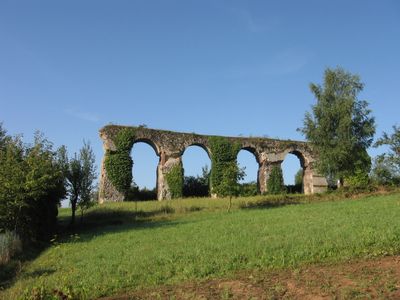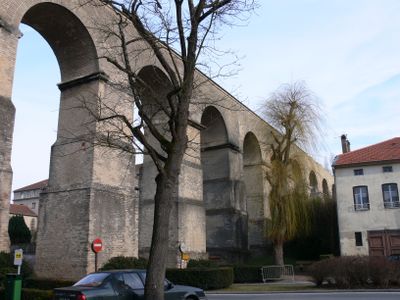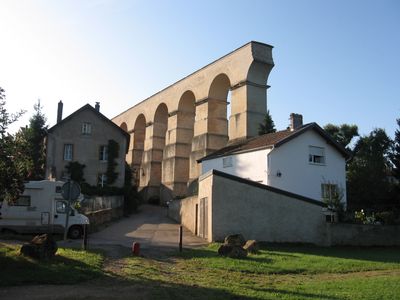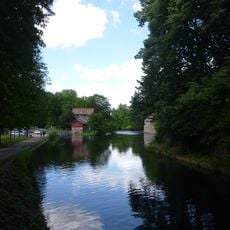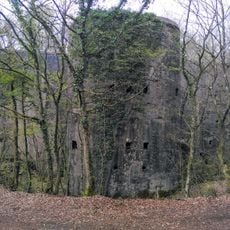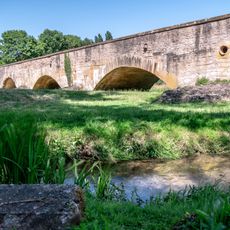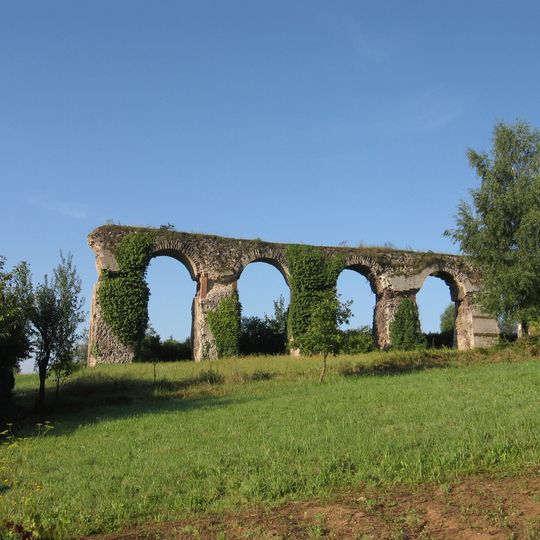
Aqueduct from Gorze to Metz, Roman aqueduct remains in Ars-sur-Moselle and Jouy-aux-Arches, France.
The aqueduct from Gorze to Metz is a Roman water channel about 22 km long, running from the Bouillons spring near Gorze (208 m) to Metz (184 m). It comprises 12.7 km of underground conduit, a 1.125 km arcade bridge between Ars-sur-Moselle and Jouy-aux-Arches, and 8 km more underground. The bridge had 110–120 arches up to 30 m high on square piers 5 m wide at the base. Remains include about twenty arches and two basins.
The aqueduct was built around the beginning of the 2nd century to bring spring water from the Bouillons source near Gorze, at 208 m, to Divodurum (Metz), at 184 m, over 22 km. It fed the city's fountains, three Roman baths, public latrines and workshops. It was classified as a monument historique on the first list of 1840, with the classification extended in 1980 and 1990.
The structure reflects Roman building practices and the use of local limestone and oak timber. It shows how the builders adapted to the landscape to move water across great distances.
You can see the remaining arches and foundations at two main locations, with walking paths connecting different viewpoints around the ruins. Wear sturdy shoes since some sections cross uneven ground and grassy areas.
Water flowed on its own through a clever system that used gravity to cross the landscape without pumps. Special basins along the way cleaned the water before it reached the city.
The community of curious travelers
AroundUs brings together thousands of curated places, local tips, and hidden gems, enriched daily by 94,550 contributors worldwide.