Pont du Diable, Historic bridge in Villemagne-l'Argentière, France
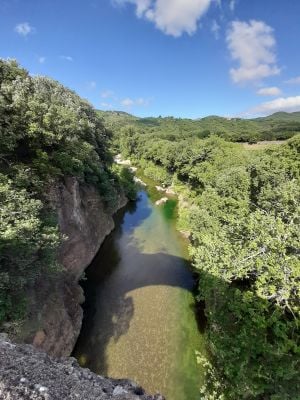
The Pont du Diable is an 18th-century stone masonry bridge in Villemagne-l'Argentière, a small town in the Occitanie region of southern France. It crosses the Mare river on two rounded arches, with the larger arch spanning the full width of the river.
The bridge was built in the 18th century to ease the transport of coal from nearby mines and support local industries such as the glassworks in Hérépian. It was listed as a protected historic monument in 1936.
The bridge takes its name from the devil, a figure common in French bridge legends, though no local tale is documented for this crossing. Its documented role is industrial: coal and lignite from Graissessac passed over it toward the royal glassworks at Hérépian. The commune owns the bridge, listed as a monument historique since 27 May 1936.
The bridge carries a narrow roadway only 4 m wide, and its profile climbs steeply from the left bank before levelling off at the crown of the arch, so the crossing is short but uneven underfoot. The Mare's bed has changed markedly since the early 20th century, and a waterfall now stands downstream of the bridge.
The roadway of the bridge slopes noticeably on the left side and becomes almost flat at the top of the arch, a design choice that likely made it easier to move heavy loads across. The central pier also features a triangular spur called an avant-bec, which deflects the water current and has helped keep the structure solid for centuries.
The community of curious travelers
AroundUs brings together thousands of curated places, local tips, and hidden gems, enriched daily by 93,461 contributors worldwide.