Château de Cœuvres, Protected castle in Cœuvres-et-Valsery, France
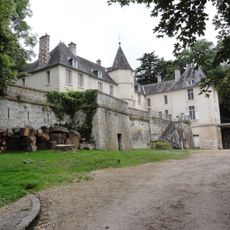
Château de Cœuvres stands in Cœuvres-et-Valsery, its light grey stone facade visible from the rue du Château. The left section carries a steep dark slate roof with two white-framed dormer windows and a tall brick chimney at its edge; below, tall multi-paned windows in white frames are set in regular bays. A lower wing with a matching dark roof extends to the right, and the stone base is plain, without openings.
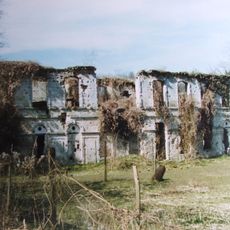
Marguerite de Soissons sold the viscountcy of Cœuvres to Jean d'Estrées; it passed to Antoine d'Estrées (c. 1530–1609), father of Gabrielle, favourite of Henri IV. In 1608 François-Annibal d'Estrées had ceilings, panelling and panels painted by Thomas Blondeau. In 1771 Louis Charles César Le Tellier left the estate to Louis Alexandre Céleste d'Aumont, duc de Villequier, who organised the flight to Varennes; the castle was seized as national property, split into four lots and left in ruins. Charles-Raymond Degranges bought the lots in 1823.
The castle's name comes from Cœuvres, the village in the Aisne where it stands. In 1608 François-Annibal d'Estrées, brother of Henri IV's favourite Gabrielle d'Estrées, had ceilings, panelling and painted panels executed by the painter Thomas Blondeau. The outbuildings were listed as monuments historiques on 28 June 1927.
The castle remains privately owned and cannot be entered, but its exterior can be viewed from public roads surrounding the property. Walking around the perimeter offers different perspectives of the main structures and outbuildings.
During World War I, the castle served as a military headquarters for several regiments and medical units. The owner at that time, Albert de Bertier de Sauvigny, documented this period and preserved its history for later generations.
The community of curious travelers
AroundUs brings together thousands of curated places, local tips, and hidden gems, enriched daily by 93,742 contributors worldwide.