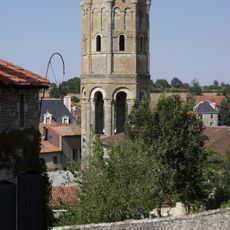
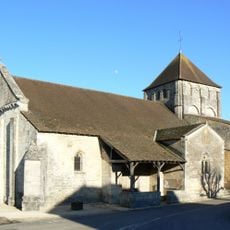
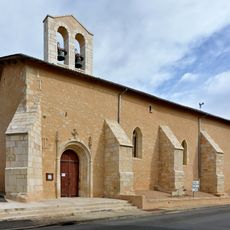
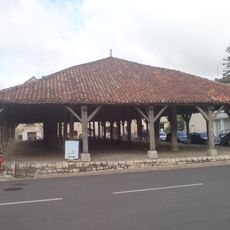
Abbaye Notre-Dame de la Réau, Romanesque abbey in Saint-Martin-l'Ars, France.
Abbaye Notre-Dame de la Réau stands on the left bank of the Clain in Saint-Martin-l'Ars. Its church is cruciform, with a choir and near-square chapels, and its corners carry 15th-century bartizans topped with machicolations. The left transept extends to a building reaching the river, with a perpendicular wing that enclosed a cloister. Two round towers reinforce the enclosure angles; the octagonal bell tower collapsed in the 20th century.
Founded in the 12th century by canons following the rule of Saint Augustine, the abbey claimed royal foundation, possibly by Louis VII or Henry II Plantagenet; a bull of Honorius III in 1219 confirmed its liberties and sixteen priories. Fortified in 1370, it was burned by the English in 1372 and later rebuilt. In 1531 the bandit Antoine de Guillerville seized it and was executed in Poitiers.
This was a religious community where monks followed the Augustinian rule and managed extensive lands and resources. The layout of the remaining buildings shows how daily monastic life was organized around work, prayer, and self-sufficiency.
The abbey stands on the left bank of the Clain, reached from Saint-Martin-l'Ars; the north side is bordered by a wide moat once crossed by two drawbridges leading to posterns. The church, chapter house, north tower and stone staircase are the elements listed under the 1941 classification, with the remaining buildings added in 1994. The octagonal bell tower collapsed in the 20th century, so the skyline differs from older views.
In 1219 a papal bull of Honorius III placed La Réau under the protection of the Holy See and confirmed its possessions; the abbey then counted sixteen priories. The same text recalls the liberties and exemptions granted by Henry II of England, which proves the monastery existed before the king's death at Chinon in 1189.
The community of curious travelers
AroundUs brings together thousands of curated places, local tips, and hidden gems, enriched daily by 93,467 contributors worldwide.