Abbaye Sainte-Croix de Quimperlé, Medieval abbey in Quimperlé, France
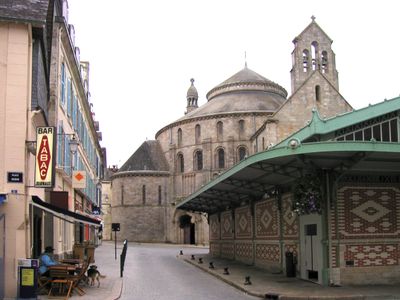
Abbaye Sainte-Croix de Quimperlé is a former Benedictine abbey whose parish church combines a central rotunda with a conical roof, a lower round tower with a dark conical roof, and a tall square bell tower with arched openings. A green-framed canopy with a tiled roof stands before a patterned brick and stone wall with a light green door.
Founded by Count Alain Canhiart of Cornouaille and his brother Bishop Orscand, the abbey's traditional date of 1029 is likely a falsification; the real foundation was around 1045–1050. In 1083 the church was restored and the relics of first abbot Gurloës were elevated. The Maurists added a 56-metre lantern tower, which collapsed on 21 March 1862, destroying most of the church; Joseph Bigot rebuilt it from 1864.
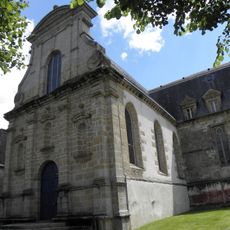
The abbey church became the parish church of Quimperlé in 1802. Its name comes from the Feast of the Exaltation of the Holy Cross, on which the foundation was traditionally dated. The 19th-century pulpit and high altar were made for the rebuilt church, while the tomb of Saint Gurloës remains in the crypt.
The abbey church became the parish church of Sainte-Croix in 1802, so it is entered from the town side rather than through the monastic enclosure. The conventual buildings were later turned into public offices, housing the civil court and the gendarmerie barracks. The church was listed as a monument historique in 1840, the cloister in 1926.
The rotunda is one of only two known Romanesque central-plan churches in Brittany, the other being Lanleff. Its layout was inspired by the Holy Sepulchre in Jerusalem. The present rotunda is a reconstruction after the 1862 collapse; the monk's choir and crypt preserve original 11th-century capitals and blind arcades.
The community of curious travelers
AroundUs brings together thousands of curated places, local tips, and hidden gems, enriched daily by 93,472 contributors worldwide.