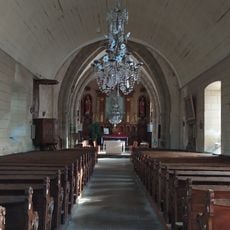
La Lucerne Abbey, Romanesque abbey in La Lucerne-d'Outremer, France
La Lucerne Abbey is a Premonstratensian complex whose church, begun before 1171 and dedicated in 1178, mixes sober Romanesque lines with an Anglo-Norman Gothic tower crowned by a balustrade. A square tower with tall arched openings and a steep pyramidal roof rises beside a long lower wing and a smaller stone building with dark rectangular windows. The nave was given a wooden vault after being ruined, and the cloister was rebuilt in stone under Abbot Richard I de Laval (1463–1490).
Founded in 1143 by Hasculf de Subligny, the abbey became the mother house for several other Premonstratensian monasteries across the region. The community's influence lasted until the French Revolution brought its suppression in 1792.
The refectory's wooden ceiling is carved to resemble a ship's hull, a detail the canons saw at every meal. In the church, recumbent effigies of the lords of Beauchamp, benefactors buried around 1300, lie in the transept chapels. The abbey's name comes from the site called la Luzerne, to which the community moved in 1162.
The abbey grounds are accessible on most days, though parking is limited near the site, so arriving early is wise. Visitors should expect uneven surfaces throughout the complex, particularly in older sections, and wear appropriate footwear.
The dovecote in the farmyard is a medieval construction, later altered, and the abbey's surviving Romanesque lavatorium is described as the only one in Normandy. The site also keeps the funerary slab of Abbot Angot, who resigned after nearly half a century as abbot and died in 1206; it was found in excavations in 1984 in the north side aisle of the nave.
The community of curious travelers
AroundUs brings together thousands of curated places, local tips, and hidden gems, enriched daily by 94,217 contributors worldwide.