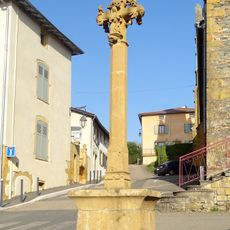
Savigny Abbey, Benedictine monastery in Savigny, France
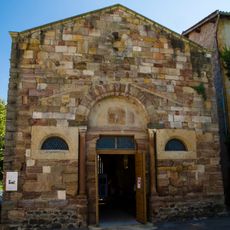
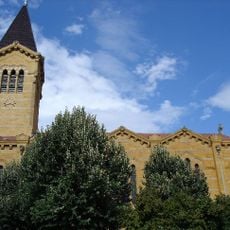
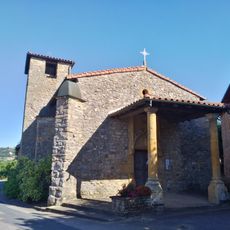
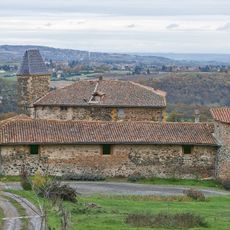
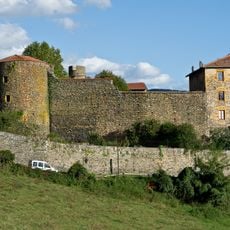
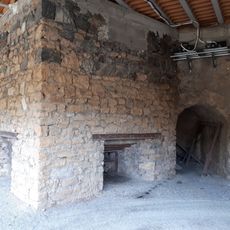
Savigny Abbey was a Benedictine monastery in the Archdiocese of Lyon. No buildings survive; only some carved stones are kept in the Musée Lapidaire of Savigny-en-Lyonnais. The site today shows a ruined stone wall beside a paved path, built of irregular rough-hewn blocks in grey, brown, ochre and reddish tones, with a flat rectangular stone plaque bearing small engraved text set into the masonry.
Leidradus founded the Benedictine abbey after resigning as bishop of Lyon in 816; a charter of 817 gives its first mention, and the Notitia de servitio monasteriorum of 819 lists it among monasteries owing the emperor only prayers. In 976 Conrad the Peaceful, king of Burgundy, confirmed its possessions and rights. Commendam brought decline, and Louis XVI ordered its closure in 1779, confirmed by Pius VI on 22 June 1780; the buildings were sold in 1784.
The abbey's name comes from Saint Martin, to whom it was dedicated. Its monks owed the emperor only prayers, with no other service, as recorded in the 819 Notitia de servitio monasteriorum. In 1139 Bernard of Clairvaux intervened in its dispute with La Bénisson-Dieu over lands in the Roannais.
The site is accessible by paths through the countryside and connects with other religious sites in the region. Visiting this place allows you to explore several monasteries across the area.
The abbey's archives survive as sub-series 1 H of the Archives départementales du Rhône, and the list of its 52 attested abbots was rebuilt by historian Pierre Ganivet from the Liber cartarum, compiled by Abbot Ponce around 1135. An 1853 cartulary edition by Auguste Bernard gave 59 names, whose dates are now treated with caution.
The community of curious travelers
AroundUs brings together thousands of curated places, local tips, and hidden gems, enriched daily by 94,657 contributors worldwide.