Roman amphitheatre of Saintes, Roman amphitheatre in Saintes, France
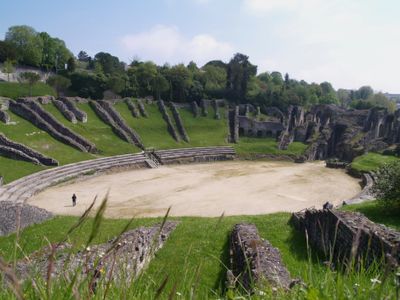
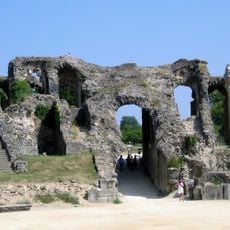
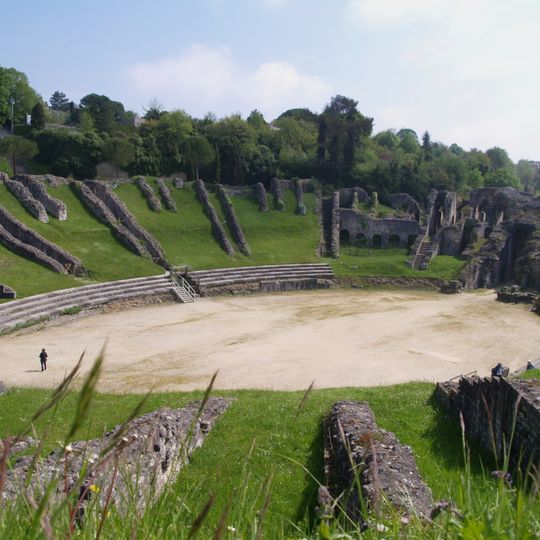
The Roman amphitheatre of Saintes is an ancient arena built into a natural valley to accommodate thousands of spectators. The structure features two main entrances designed to manage the flow of crowds during events and performances.
Construction began under Tiberius (14–37 AD) and was completed in the 40s AD under Claudius, whose name appears on an inscription fragment found in the monument. The arena was refurbished around 275 AD and stayed in use into the first half of the 4th century; Bastien Gissinger dates its abandonment to the late 4th or more probably the 5th century. It was later quarried for stone, listed as a monument historique in 1840, and its arena was cleared in 1906.
The two entrances carry traditional names from the 19th century: the eastern gate is the Porte des Vivants, the western the Porte des Morts. On the south side, a small spring called the Fontaine Sainte-Estelle recalls the legend of Saint Estelle, daughter of a Roman governor converted by Saint Eutropius, first bishop of Saintes.
The site sits on a slope and requires walking on uneven ground with several steps and inclines. Visitors should wear comfortable shoes and allow time to explore both the lower arena level and the upper seating areas.
The structure cleverly used the natural valley shape to seat around 15000 spectators without needing to build massive support walls. This resourceful approach demonstrates how Roman builders worked with the landscape rather than against it.
The community of curious travelers
AroundUs brings together thousands of curated places, local tips, and hidden gems, enriched daily by 94,419 contributors worldwide.