Belfry of Béthune, Belfry in Béthune, France
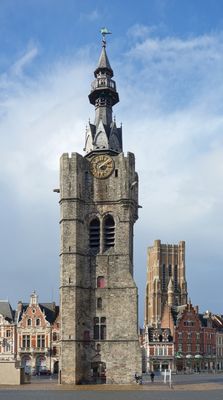
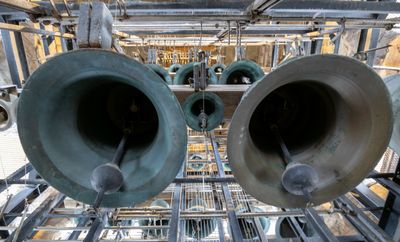
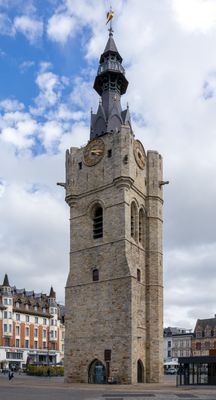
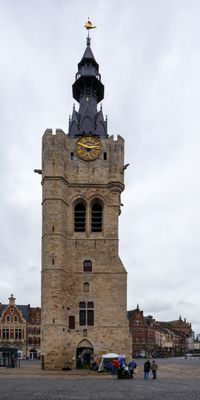
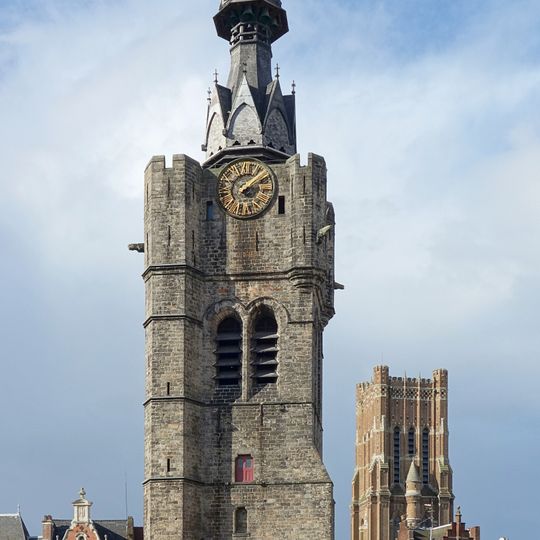
The Belfry of Béthune is a square sandstone tower on the Grand-Place, 33 metres high and topped by a 17-metre campanile crowned with a dragon named Beffy. It has four floors reached by 133 steps, with hexagonal turrets at its corners and a belfry housing 35 bells.
A first wooden belfry was built in 1346 and burned down; in 1388 Guillaume I of Namur authorized a sandstone reconstruction. A third floor was added in 1437, and the carillon grew from six bells in 1546 to 36 in 1773. German artillery damaged the tower in 1918, and it was rebuilt identically from 1921 to 1923, using sandstone from the ruined Saint-Vaast church.
The bells ring out during local celebrations and important civic moments, maintaining a tradition that shapes the rhythm of life in Béthune. This practice keeps the tower connected to daily events and community identity.
The tower stands in the middle of the Grand-Place and is reached on foot from the surrounding streets. Its four floors are climbed by 133 steps, and the top level opens onto the walkway and the clock room. The sandstone facing was partly rebuilt after 1918 with stone taken from the ruined church of Saint-Vaast.
The tower is 33 metres high, and its 17-metre campanile carries a dragon named Beffy. The belfry itself served as the model for the logo of the former Nord-Pas-de-Calais region.
The community of curious travelers
AroundUs brings together thousands of curated places, local tips, and hidden gems, enriched daily by 94,330 contributors worldwide.