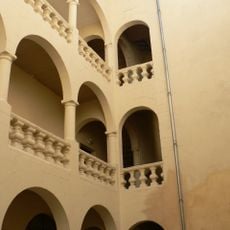
Calvaire des Récollets, Religious historic site in Romans-sur-Isère, France
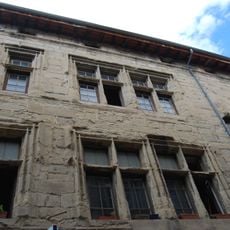
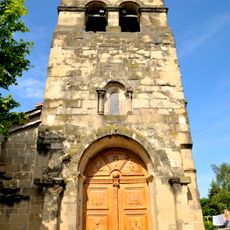
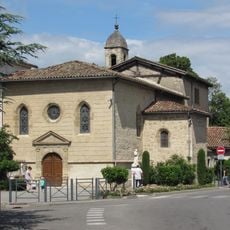
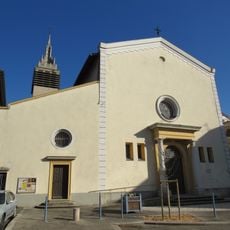
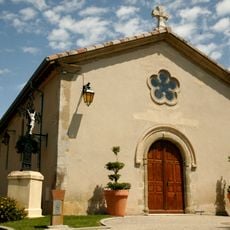
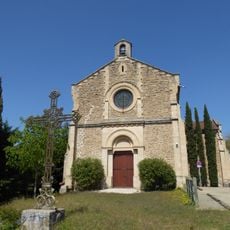
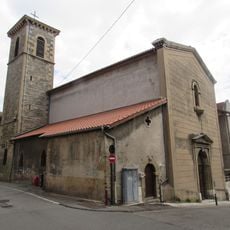
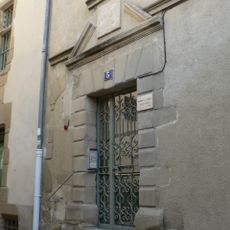
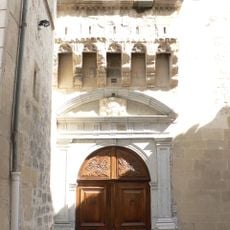
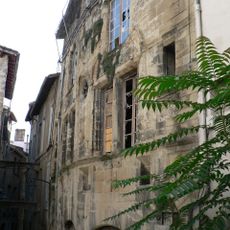
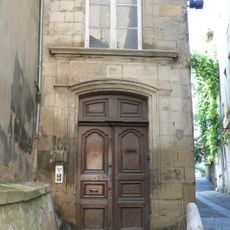
The Calvaire des Récollets stands on a rise a quarter of a league outside Romans-sur-Isère, a walled enclosure holding a reconstruction of the Holy Sepulchre and, since 1820, 19 stations of the Cross; 21 more stations run through the town streets. The enclosure also holds the funeral chapels built by wealthy Romanais families. Beside the dirt path, a low stone wall fronts a rubble-stone wall with a metal grille, an ornate light-stone facade with pointed arches, circular medallions and a stepped gable topped by a small tower, a classical building with a triangular pediment above a rounded arch, and a lower stone structure with a small arched doorway.
Romanet Boffin, a wealthy merchant of Romans-sur-Isère, designed the Way of the Cross and calvary in 1516 to replace the pilgrimage to Jerusalem, made dangerous by the Turks. Two Franciscans returning from Palestine found the town's topography similar to Jerusalem's; Boffin, who had travelled there himself, built 14 stations ending at a calvary outside the walls. The first stone was laid on 15 March 1517 on land near a small hermitage, with rights ceded by the Archbishop of Vienne.
The site is a romantic cemetery, classified as a Monument historique since 1986, where wealthy Romans-sur-Isère families built funeral chapels. The name recalls the Récollets, the Franciscan branch to whom the calvary was entrusted after its sack in 1562. A local proverb, "Cela dure comme la barral du Mont-Calvaire", recalls the wine barrel that supposedly never stopped flowing during construction.
The calvary stands on a hill about a quarter of a league outside the old town, near the former hermitage site, and is reached on foot. The enclosure was abandoned at the end of the 19th century and only cleared again from 1967 by the Association des Amis du Calvaire. Expect an outdoor, uneven ground among the funeral chapels.
The site's name recalls the Récollets, the reformed Franciscans who were given the calvary after it was sacked in 1562 during the Wars of Religion. A local proverb, "Cela dure comme la barral du Mont-Calvaire", grew from a legend that a barrel of wine brought to the builders never ran dry until the work was finished.
The community of curious travelers
AroundUs brings together thousands of curated places, local tips, and hidden gems, enriched daily by 93,668 contributors worldwide.