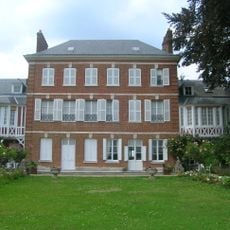
Château d'Ételan, Flamboyant Gothic château in Saint-Maurice-d'Ételan, France
Château d'Ételan is a flamboyant Gothic mansion built from 1494 for Louis Picard at Saint-Maurice-d'Ételan, on the right bank of the Seine. Its two lodges of alternating brick and pale stone are joined by a stone stair gallery of the first Renaissance; the left wing has a slate roof and two pinnacled dormers, the taller right pavilion three levels of tall windows, the lower ones arched, above a low arched door.
Louis Picard, bailiff of Troyes and Tournai and chamberlain to Louis XII, began the present château in 1494 on the site of a fortress razed by order of Louis XI; only a cellar, an enclosing wall and the 1350 guard house survive of the medieval building. In August 1563 Catherine de' Medici, regent, and the young Charles IX stayed here after retaking Le Havre from the English, and at Ételan on 4 August she had the letters of the king's majority drawn up, signed and sealed a year early. The château stayed with the maréchaux de Brissac until 1621, passed by marriage to the Épinay de Saint-Luc, was sold in 1714 to Charles Hénault, and was restored in the 19th century before a fire in November 1940.
The name Ételan comes from Esteilant (1050–1066), an Old English place name meaning "steep land", brought by Anglo-Scandinavian settlers. The chapel, dedicated to Mary Magdalene, holds 16th-century stained glass, wall paintings and polychrome statues of the first Norman Renaissance, plus a 16th-century font and 17th-century piscina. Three multi-centenary lime trees in the 20-hectare park were classed "Arbres remarquables" in 2010.
The castle is open to visitors during certain periods throughout the year, and guided tours are offered during specific seasons. Check ahead before your visit since opening times vary depending on the time of year and local events.
A marble plaque in the cabinet d'Ételan lists the estate's owners since 1383. The château also keeps a guard house dated 1350, a cellar and an enclosure wall from the fortress razed on Louis XI's orders; three multi-centenary lime trees in the 20-hectare park were classed "Arbres remarquables" in 2010.
The community of curious travelers
AroundUs brings together thousands of curated places, local tips, and hidden gems, enriched daily by 93,494 contributors worldwide.