Chapelle Sainte-Croix de Forbach, Late Gothic chapel in Forbach, France
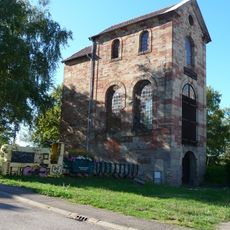
Chapelle Sainte-Croix is a late-Gothic hall chapel built of rough reddish-brown and tan sandstone blocks, with a square nave and a choir of less regular masonry. The two parts are offset in axis, showing they were originally separate structures. The choir has Gothic windows, one partly walled up, and inside is a 13th-century carved tympanum depicting Christ on the cross.
The present building likely rose between the mid- and late 13th century, with the choir dating from the second half of that century. It is first documented in 1338, when Bishop Adhémar of Metz named it capella Sancta crucis juxta Forbachum in a letter to the chapter of St. Stephanus in Oberhomburg. It was heavily reworked in the 14th and 15th centuries and damaged in the Thirty Years' War, possibly during the Swedish presence of 1635.
The chapel is also called Annenkapelle, and a local legend tells of Alice de Forbach, who founded an oratory on the hill and was buried at the foot of the altar; she was never canonised. A 13th-century carved tympanum showing Christ on the cross can be seen inside.
The chapel can be reached on foot by climbing Kreuzberg hill, and visitors should be prepared for an uphill walk. Information about opening hours and events is available from Forbach's municipal office.
The chapel's origin is uncertain: it may have been a fortified house or a dependency of a castle. Inside, a 13th-century carved tympanum shows Christ on the cross. At the foot of the altar, a rock-cut tomb with a head niche, holding a tall, frail woman, was found on 24 November 1978.
The community of curious travelers
AroundUs brings together thousands of curated places, local tips, and hidden gems, enriched daily by 93,859 contributors worldwide.