Château d'Anterroches, Medieval castle in Murat, France
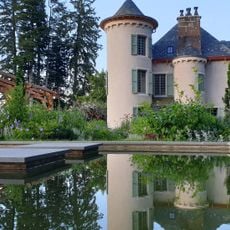
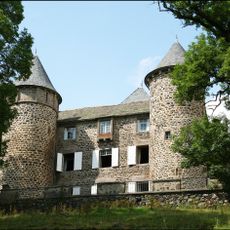
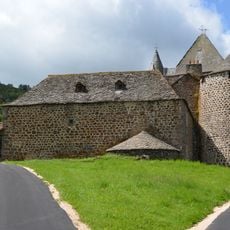
Château d'Anterroches is a castle in the Alagnon valley, in Murat, built of pale grey stone. Its central block has a steep dark grey hipped roof with dormer windows and two tall square stone stacks, flanked by three round towers with conical grey roofs and narrow windows. A lower wing stands on the right, and a low stone wall runs along the base.
Anteroche is first mentioned in 1351 in a homage by Pierre de Chambon to Renaud de Pons, viscount of Carlat. In 1478 Juliane du Chambon and her husband Jean de Layre sold it to Jean de Traverse, who built the rectangular keep. The west wing was added in the 18th century, and from 1890 to 1906 architect Jean Delpirou enlarged and reworked the castle in the troubadour style. It was inscribed as a monument historique on 7 April 2008.
The name Anterroches comes from the Latin ante roccam, meaning "before the rock", referring to the castle's position facing a huge boulder. The spelling with two r's and a plural is incorrect but became the surname of the Traverse branch that owned the estate. The family died out in 1780 with Louise-Marthe-Catherine d'Anterroches.
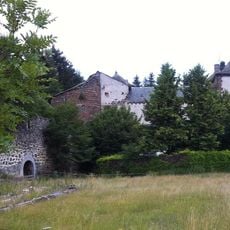
The castle is located at Murat's entrance and is clearly visible from the road when arriving from Laveissière. You can admire the exterior structure, but the interior is not open to visitors.
Guillaume de Traverse, physician to Charles VII and then Louis XI, was ennobled in 1459 and granted the confiscated seigneurie d'Antraygues, exempt from military service. His son Jean bought Anterroches in 1478 and built the rectangular keep. The family later produced Joseph Charles Alexandre d'Anterroches, credited with the retort at Fontenoy, "Messieurs les Anglais, tirez les premiers!"
The community of curious travelers
AroundUs brings together thousands of curated places, local tips, and hidden gems, enriched daily by 94,591 contributors worldwide.