Château d'Apchon, Medieval castle in Apchon, France
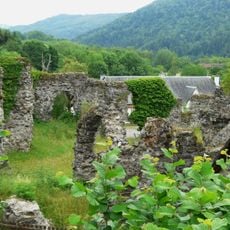
Château d'Apchon stands on a basaltic dyke at 1,100 metres above the Rhue, Santoire and Marilhou valleys. Its surviving enceinte is flanked by five round towers and two engaged towers. The photograph shows dark grey weathered masonry rising straight from the rock, with three wall sections still standing: a lower wall on the left and, to its right, a taller section pierced by two tall rounded arches with a narrow opening between them. No roof or floors remain.
A fortress likely built in the 12th or 13th century, it was rebuilt between 1408 and 1422. During the Hundred Years' War it stood between English-held land and territory still controlled by the king of France, was attacked several times, and served as a base for the reconquest of Limousin. It was no longer habitable by 1760.
The castle gave its name to the Apchon family, one of the most powerful noble houses of Haute-Auvergne. The village of Apchon grew below the outcrop, and the family's seat stood above it until the castle was no longer habitable in 1760. In 1852 the painter Auguste Bonheur made it the subject of a painting.
The location sits at considerable elevation, so weather conditions can shift quickly and ground access varies with the season. Visitors should come prepared with sturdy footwear and weather-appropriate clothing to comfortably navigate the terrain and explore the ruins.
The castle stands on a basaltic dyke at 1,100 metres, above the Rhue, Santoire and Marilhou valleys. In 1852 the painter Auguste Bonheur made it the subject of a painting, a trace of the ruin as it appeared before any restoration.
The community of curious travelers
AroundUs brings together thousands of curated places, local tips, and hidden gems, enriched daily by 93,839 contributors worldwide.