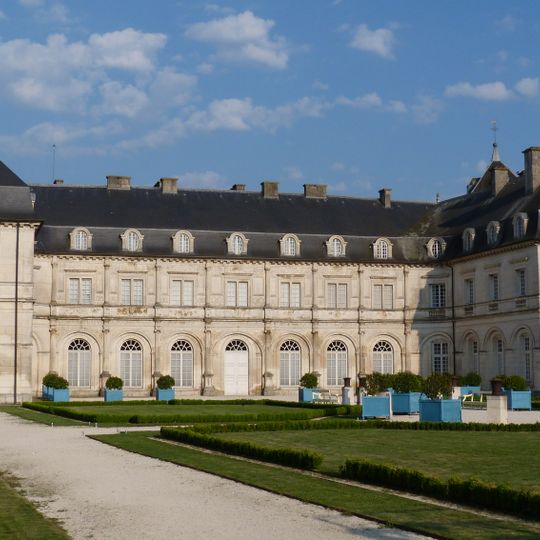
Château de Champlitte, Renaissance castle in Champlitte, France.
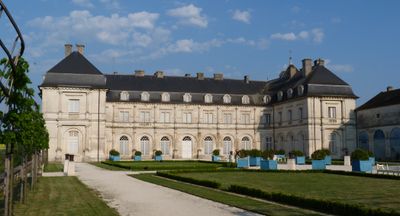
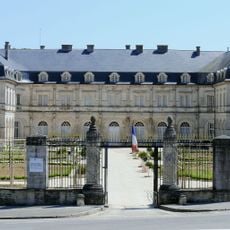
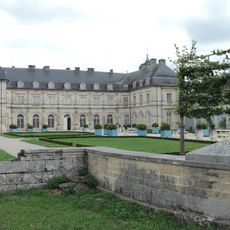
Château de Champlitte is an 18th-century building in Champlitte, Haute-Saône, now housing the Musée départemental d'Arts et Traditions populaires. Its pale cream facade has three levels of windows, a steep dark slate roof with arched dormer windows and tall chimneys, and a right wing ending in a rounded corner tower with a conical roof. A gravel path and low hedges run in front.
A fortified castle is documented in the Middle Ages, built by the lords of Fouvent on the hill above Champlitte-la-Ville; the town was besieged four times and pillaged eleven times in three centuries. Around 1560–1564 François de Vergy added a Renaissance wing, possibly by a Flemish architect named Nicolas Morris. On 19 February 1751 a fire started in a heated cabinet of papers and destroyed the whole castle within six hours, sparing only the kitchens and offices; the Toulongeon family rebuilt it in the 18th century, and it now houses the departmental museum of arts and popular traditions.
The château houses the Musée départemental d'Arts et Traditions populaires. Its collections document daily life and crafts in the Haute-Saône, and the site keeps alive the memory of the counts of Toulongeon, who owned the seigneurie of Champlitte until the line passed by inheritance in the 17th and 18th centuries.
The castle stands on the hill above the town, near the older Gallo-Roman settlement of Champlitte-la-Ville in the valley 1.3 km away. The museum occupies the rebuilt 18th-century building; the town's medieval layout, with the Tour des Annonciades, Tour Charles Quint and the old ditch, can be read in the surrounding lanes on foot.
One salon preserves the original wallpapers from the Enlightenment period, reflecting the refined taste of the Toulongeon family. These papers reveal how wealthy households decorated their rooms in the 18th century.
The community of curious travelers
AroundUs brings together thousands of curated places, local tips, and hidden gems, enriched daily by 94,461 contributors worldwide.