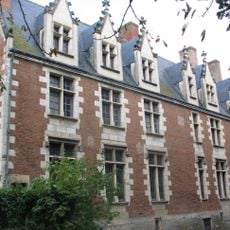
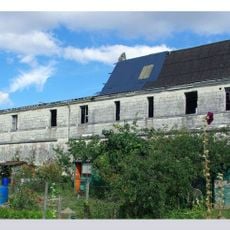
Château de Chatigny, Historical castle in Fondettes, France
Château de Châtigny stands on a slope above the Loire valley in Fondettes, built in 1487 on Gallo-Roman foundations over four metres high on the south side. Two wings meet the main range at right angles, each fronted by a round tower with a conical roof; the larger tower shows a chequered pattern of light and dark stone. A curtain wall, partly destroyed around 1800, closes the north side of the courtyard.
The castle was built in 1487, constructed over the site of an ancient Roman estate from the 3rd century that had previously occupied the location. This shift from Roman to medieval use reveals how the place remained a significant center across multiple centuries.
The name Châtigny derives from the Latin Catiniacus, recorded in royal acts of 862, 920 and 922. The checkerboard masonry of alternating light and dark stones is a Norman technique rarely found south of Normandy; in the Touraine region only Châtigny, the Château de Velors at Beaumont-en-Véron and the Château de Jallanges use it.
The castle is a private residence, so the interiors are not open to visitors. The Roman ruins, the park and the surroundings can be visited 40 days a year, in July, August and September. The grounds lie in the southwest of Fondettes, bounded by Rue de Châtigny, Rue des Roulets and the RD 76 (Rue de Gannay).
West of the courtyard stand the ruins of other Gallo-Roman buildings: an indoor pool, an octagonal outdoor basin and a hypocaust. Some authors suggested public baths here, since the villa bordered the Roman road from Tours to Saumur. The mosaics were moved to the Musée archéologique de Touraine.
The community of curious travelers
AroundUs brings together thousands of curated places, local tips, and hidden gems, enriched daily by 94,582 contributors worldwide.