Cimetière Marin, Sète, Maritime cemetery on Mediterranean hills in Sète, France.
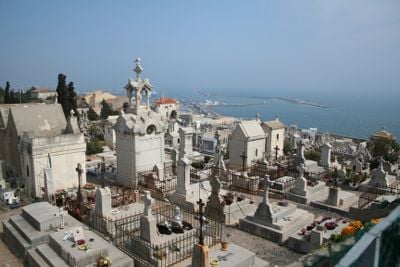
Cimetière Marin, also called Saint-Charles, stands on a plateau above the Gulf of Lion in Sète. Its sloping ground holds dense above-ground tombs of pale grey and white stone and marble: tall monuments with carved pillars, crosses and small pinnacles, plain slabs, and several plots enclosed by black iron railings. A large monument with a sculpted figure lies in an iron enclosure in the lower foreground, and the cemetery overlooks the sea and a distant coastline.
Created around 1680 to bury the first workers building the Saint-Louis mole, it was long called Saint-Charles. On 7 August 1945 it was renamed Cimetière marin after Paul Valéry, buried there a few days earlier, and his 1920 poem of that title. Locals call it the "cemetery of the rich", as opposed to Le Py.
Locals call it the "cimetière des riches", as opposed to the Le Py cemetery, nicknamed "des pauvres", across the Thau lagoon. On 7 August 1945 it was renamed Cimetière marin after Paul Valéry's 1920 poem, days after the poet was buried here. Georges Brassens, buried at Le Py, sang of wanting a cemetery "plus marin que le sien".
The cemetery sits at an elevated location, so visiting requires some physical effort to climb stairs and walk the terraced paths. Access is on foot and the white tombstones are visible from a distance, making it easy to find your way around.
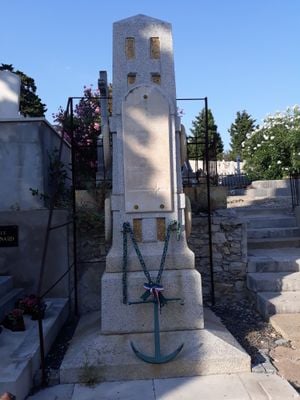
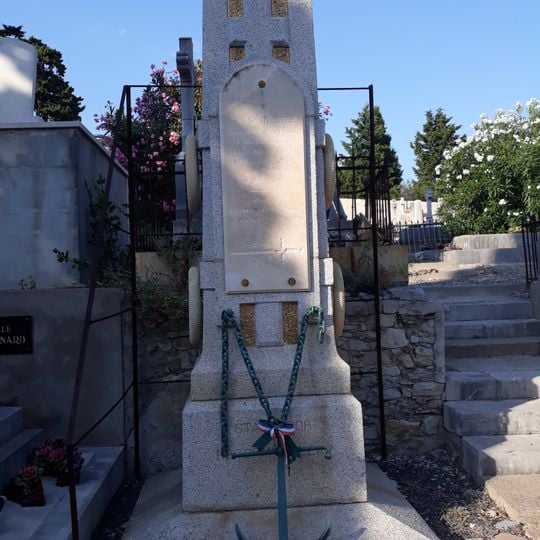
Eugène Herber (1878–1900), known as the "Aspirant Herber", is buried here; he was killed in China defending the besieged French legation during the Boxer War. A quay in Sète and a former French destroyer (1912–1930) both carry his name. His tall granite memorial, with an anchor leaning at its base, stands among the tombs.
The community of curious travelers
AroundUs brings together thousands of curated places, local tips, and hidden gems, enriched daily by 92,890 contributors worldwide.