Château de la Noë Bel-Air, 19th-century castle in Vallet, France.
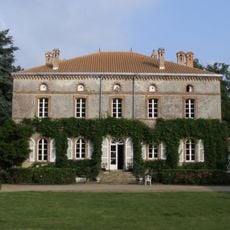
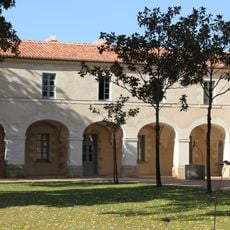
Château de la Noë Bel-Air is a rectangular building whose north-northwest front carries a two-storey columned loggia, with a projecting flat-roofed portico of ten smooth columns on the left and rusticated quoins framing the right section. The orangery and outbuildings date from 1823-1826. It stands in a landscaped park enclosed by a low wall with small round towers at several corners.
A noble house on the site burned during the Wars of the Vendée; the present château was rebuilt on its ruins between 1835 and 1837 by architect Louis-Joseph Chaigneau for Armand de Malestroit de Bruc de Montplaisir. The orangery and outbuildings date from 1823-1826. The monument was listed in 1974, inscribed in 1998 and classified in 1999, together with the orangery, outbuildings, park, henhouse, dovecote, courtyard, elevation and landscaped river.
The Italianate style mixed with Empire elements was strongly inspired by François-Frédéric Lemot, whose pupil Louis-Joseph Chaigneau designed the rebuilding for Armand de Malestroit de Bruc de Montplaisir. In the park, a sculpted Virgin by Grootaërs dates from 1846, and an eastern stele recalls Royalists shot in 1793; the grounds served as a rallying point for Kléber's army camped nearby.
The location lies about 25 minutes from Nantes and offers multiple spaces for events, primarily available from April to October. Visitors can use the spaces flexibly and freely choose external catering services.
The property is surrounded by a classified park that serves as a protected natural site, shaping the surrounding landscape. This protected status underscores the ecological importance of the location within the Loire-Atlantique region.
The community of curious travelers
AroundUs brings together thousands of curated places, local tips, and hidden gems, enriched daily by 93,172 contributors worldwide.