Château de Fayet, Renaissance castle in Fayet, France.
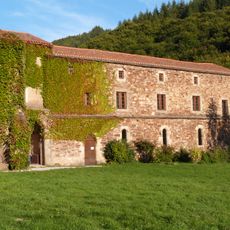
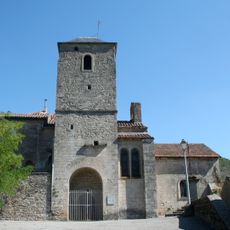
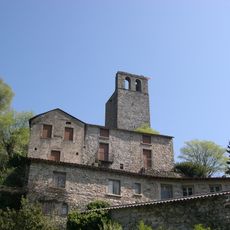
Château de Fayet stands on a hillock above the valley, a regular parallelogram of rough light-brown and grey masonry. Its left section is a tall, narrow tower-like wing with small windows, one shuttered in dark red-brown, and a dark wooden door at the base. The broader facade to the right has a row of shuttered windows and, along its base, small stone arches over a large arched doorway with brown wooden double doors and a smaller arched door.
The first lords of Brusque and Fayet were the viscounts of Albi in the 11th century, followed by the viscounts of Béziers and Carcassonne, the counts of Toulouse and, in the 14th century, the lords of Castelnau-Bretenoux. In the 16th century Jacquette de Clermont brought a dowry that paid for restoration and enlargement after her marriage to Jean V d'Arpajon. During the Revolution the castle was sold by the duchess of Biron before her husband, marshal of France, was guillotined; in 1999 Pierre Dussert bought it and founded Les Amis du Château de Fayet.
The castle's name comes from the Fayet seigniory, held from the 11th century by the viscounts of Albi and later by the Castelnau-Bretenoux. Henri de Navarre, the future Henry IV, stayed here and saw living rooms hung entirely with papered decorations painted with dyes by Rougier de Camarès; these paintings inspired frescoes, notably on the ceilings, with symbols of the Compagnons du Devoir and representations of the arts.
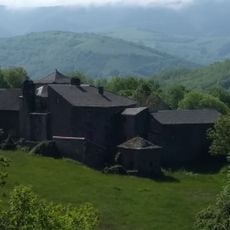
The castle stands on a hillock above the valley, reached by a long alley bordered with lime and chestnut trees that leads to the eye-shaped main courtyard. The site is currently for sale and has hosted events and visitors; access to the interior depends on the owner, so check locally before travelling. The grounds are part of the Route des Seigneurs du Rouergue itinerary of 23 Aveyron castles.
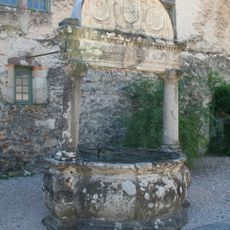
The eye-shaped main courtyard holds a fountain with a double basin and a well; the stone edge wall, shaped like a pot, is carried by two pillars built in 1564 by Guy de Castelnau. The castle is one of 23 Aveyron castles joined in the tourist itinerary La Route des Seigneurs du Rouergue.
The community of curious travelers
AroundUs brings together thousands of curated places, local tips, and hidden gems, enriched daily by 94,055 contributors worldwide.