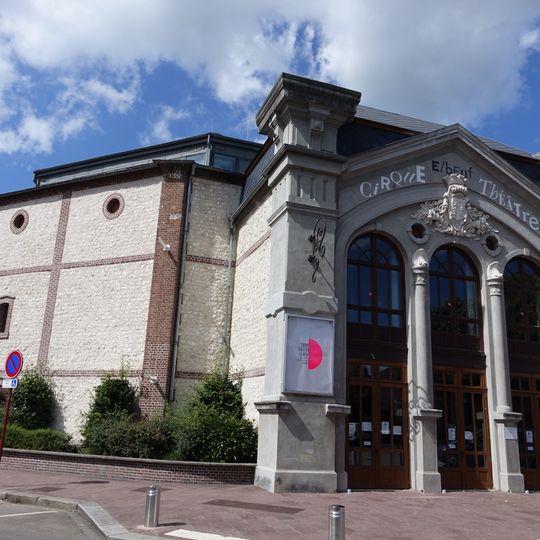
Cirque-Théâtre d'Elbeuf, Historical theatre and circus building in Elbeuf, France
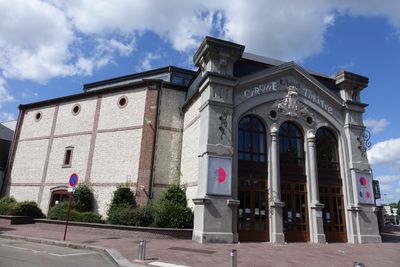
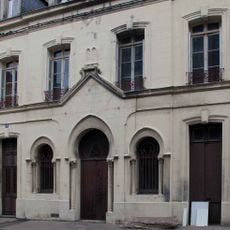
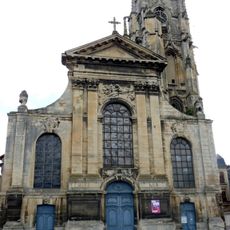
The Cirque-Théâtre d'Elbeuf combines a rough pale stone wall banded with red brick and two round windows with a grey stone entrance pavilion whose tall pillar curves over three arched openings framed by columns. Carved above the arches are the words "Cirque" and "Théâtre" with a crest between them. Behind this facade, an octagonal cast-iron and iron-truss structure rises to a 28-metre dome topped by a lantern, with seating around a 13.5-metre circular ring and an Italian-style stage.
Inaugurated in 1892, the building was designed by the Elbeuf architects Laquerrière father and son with contractor Henry Blanchet, and originally held 2,000 seats, later up to 2,200, with stables for 35 horses. Converted into a cinema in 1942, it was bought by the city in 1957 and turned into a trade union and veterans' hall with a gymnasium in 1967. Inscribed as a monument historique in 1998, it reopened as a performance venue in 2007 after three years of works costing ten million euros.
The carved lettering "Cirque" and "Théâtre" above the three arched openings states the building's double role. Since 2016 the venue has been a Pôle national cirque, one of two in Normandy, and its director Yveline Rapeau also heads La Brêche in Cherbourg-Octeville, linking the two houses in a shared production and touring platform. Around 80 performances a year draw more than 20,000 spectators each season.
The entrance pavilion on the right of the facade carries three arched openings with dark wooden doors and windows, framed by columns and topped by carved lettering reading "Cirque" and "Théâtre"; a square poster panel on the pillar announces the programme. The building sits in Elbeuf, in Seine-Maritime, and is run as a Pôle national cirque with around 80 performances each season, so the interior is normally seen during a show.
This is one of France's last permanently operating circus buildings, preserving a rare building type that nearly disappeared. Its combination of a fixed circus ring and a classical theater stage makes it an unusual example of how entertainment was approached in the 19th century.
The community of curious travelers
AroundUs brings together thousands of curated places, local tips, and hidden gems, enriched daily by 94,760 contributors worldwide.