Cirque de Mourèze, Dolomite cirque in Mourèze, Hérault, France
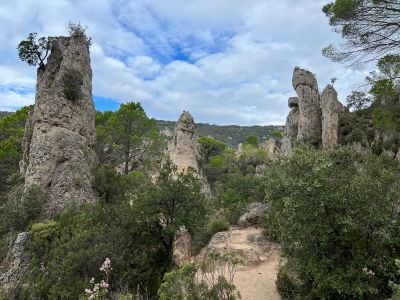
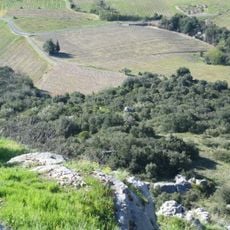
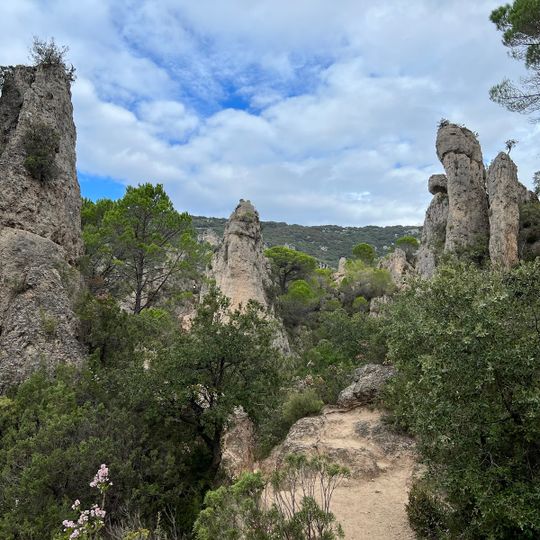
The Cirque de Mourèze is a 340-hectare dolomite cirque in the Hérault, about 160 million years old, where differential dissolution of dolomite in a strongly jointed massif has produced a ruiniform field of rock panels and pinnacles. Named columns include the Sphinx, the Guardian, the Oracle, the Bear and the Shepherd, the Hauts Fourneaux, Cerberus and the Tour du Guetteur.
The site was first excavated by G. Vasseur in 1911, with results published in 1914; Late Bronze Age III finds are held at Marseille's musée Borély. In 1940 the writer Gaston Combarnous settled at Mourèze and made the first cartogram of the cirque, naming most of its rocks. Excavations at Les Courtinals in 1991, led by Dominique Garcia, uncovered a well-preserved Bronze Age hut and Chalcolithic foundations.
The pinnacle names come from Gaston Combarnous (1892–1987), a writer who settled in Mourèze in 1940 and made the first cartogram of the cirque, naming most of the rocks: le Sphynx, le Gardien, l'Oracle, l'Ours et le Berger, le Cerbère. Postcards sold in the village labelled the phallus-shaped pinnacle "le zizi", and Jean-Pierre Mocky filmed a scene there for Le Bénévole.
The area has marked hiking trails ranging from one to three hours depending on the route chosen, with parking available at the village entrance. Wear sturdy footwear since the paths cross uneven terrain and can become muddy after rain.
Gaston Combarnous (1892–1987), who settled in Mourèze in 1940, made the first cartogram of the cirque and named most of its rocks, including the Sphynx, the Guardian and the Oracle. One phallus-shaped pinnacle appeared on postcards sold in the village captioned "le zizi", and Jean-Pierre Mocky filmed a scene there for Le Bénévole.
The community of curious travelers
AroundUs brings together thousands of curated places, local tips, and hidden gems, enriched daily by 93,153 contributors worldwide.