Couvent des Cordeliers, Dinan, 13th century Franciscan convent in Dinan, France.
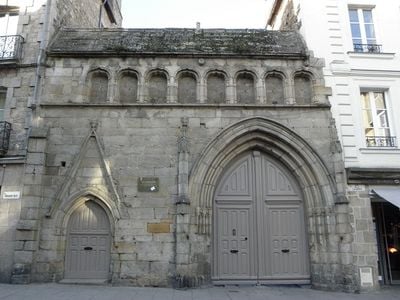
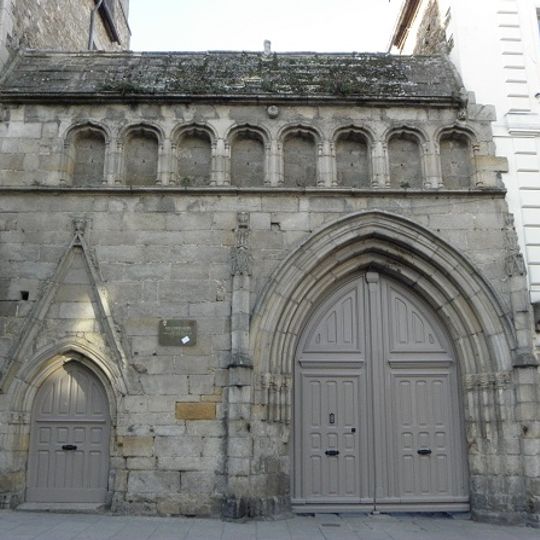
The Couvent des Cordeliers is a 13th-century Franciscan convent in Dinan. Its facade is built of light grey and tan masonry blocks, weathered with darker patches, and topped by a sloping roof line covered in dark moss or lichen. A row of eleven recessed, round-arched niches runs across the full width. At ground level, a small pointed-arched doorway with grey double doors stands on the left, and on the right a large pointed-arched portal with deeply stepped mouldings holds tall grey double doors with panels. Between them is a small dark plaque with light, unreadable text above a plain rectangular stone panel.
The convent was established between 1247 and 1249 on the ruins of a castle, founded by Henry d'Avaugour as a home for Franciscan monks. The founder later took monastic vows himself and was eventually buried within the convent walls.
The convent has housed a private Catholic school since 1804, when Abbé Berthier settled here after returning from the Rochefort hulks. A stained-glass window in the school chapel recalls the 14th-century painting of Saint Francis and Charles de Blois that, according to the account, bled when struck by a knight of Jean IV.
The complex functions today as a private school, so visitor access is limited and may depend on school schedules and special arrangements. It is best to inquire in advance about whether the buildings can be viewed and at what times.
Among the pupils were the corsair Robert Surcouf (1773–1827) and the writer Chateaubriand (1768–1848), who attended the Collège des Laurents, the school that became the Collège des Cordeliers after the Revolution. The writer Charles Poirier took the pen name Jean Cordelier in memory of his studies here.
The community of curious travelers
AroundUs brings together thousands of curated places, local tips, and hidden gems, enriched daily by 93,053 contributors worldwide.