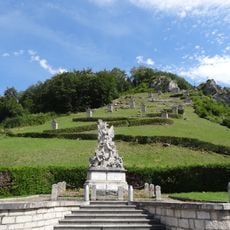
Puits de Jardel, Natural sinkhole in Chaffois, France.
The Puits de Jardel, also called gouffre de Jardel, is a 128-metre-deep shaft in the karst of Chaffois, a few kilometres from Pontarlier. It formed when the roof of a large underground chamber collapsed at an undetermined period. Its rim is jagged rough stone and earth with no built edge or marker, and the shaft narrows downward before opening into a darker void.
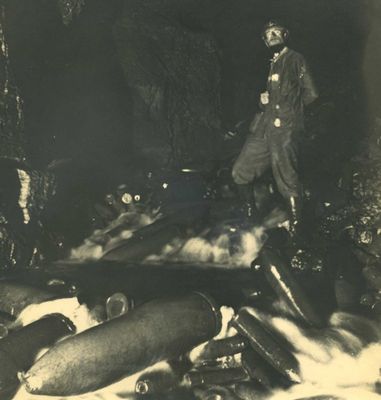
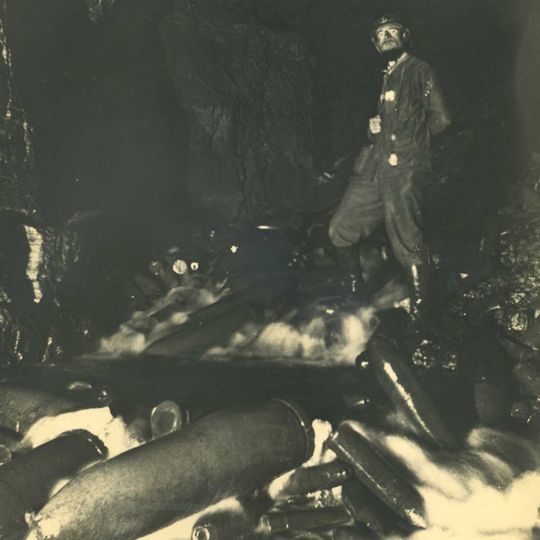
The sinkhole was used in the early 20th century by French military authorities to store leftover ammunition from World War I underground. This military use transformed it into one of the region's largest natural munitions storage sites.
Locals long used the shaft as a "bêtoire", a dumping place for dead animals, a practice common in the region until the late 19th century; about 1,500 animals that died of typhus were thrown in during the Franco-Prussian War of 1870. Around ten surrounding villages relied on the Trou de Jardelles this way. The site is now closed off by fencing and municipal order, so it can only be viewed from outside.
The sinkhole is secured with fences and warning signs, and access is not freely available. Visitors should respect the barriers in place, as environmental protection and other safety measures restrict entry to the area.
In 1901, dye poured into the water at the bottom of the shaft reappeared about 24 hours later at the sources of the Loue, and part of that water reached taps in the village of Ouhans. A later assessment held that the water actually resurges at a secondary downstream spring, so pollution monitoring had to be revised.
The community of curious travelers
AroundUs brings together thousands of curated places, local tips, and hidden gems, enriched daily by 94,463 contributors worldwide.