Gué de Maulny, Public park in Le Mans, France
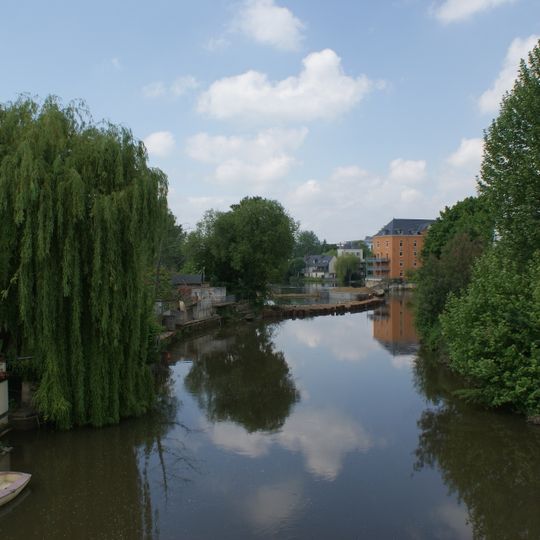
Gué de Maulny is a 16-hectare public park in the south-west of Le Mans, on the bank of the Huisne between the south railway station and the ring road. It holds an open plain, play areas, a few private gardens and a small wood, and looks across the water to the one remaining mill.
The ford of Maulny was a main crossing from Gallo-Roman times, the most direct route from Le Mans to Allonnes, and later also toward Arnage. The Valois built a pleasure castle here, the Château du Gué-de-Maulny, where the future King John II the Good was born in 1319. Plundered and ruined during the Hundred Years' War, it was destroyed in 1359 as the English advanced on Le Mans; its chapel was destroyed too, and the chaplains took refuge in the city.
Since 2018 the park has hosted the Plein Champ urban art festival, mixing urban music with mural painting. Artists have included Nadège Dauvergne, Petite Poissone, the German Case Maclaim and the Mexican Zoer, and visitors can paint in free-expression areas. The name recalls the former ford (gué) that linked Le Mans with Allonnes.
The park is located near Le Mans train station and is easy to reach on foot with good pathways throughout the grounds. Visitors should be prepared for open spaces with limited shade, especially on the meadow areas along the water.
The park keeps a single water mill on the Huisne, restored in 2007 after the town bought the mills in 1862; they served as a water-treatment plant until 1907. A wooden footbridge built by the municipality in 1987 links the park to the left bank of the river.
The community of curious travelers
AroundUs brings together thousands of curated places, local tips, and hidden gems, enriched daily by 92,789 contributors worldwide.