Hôtel Bullioud, Renaissance private mansion in 5th arrondissement of Lyon, France.
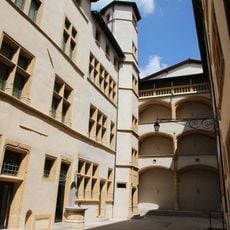
The Hôtel Bullioud stands at the back of a courtyard reached through a traboule at 8 rue Juiverie, in Lyon's 5th arrondissement. Philibert Delorme built its gallery in 1536, linking two houses with corner pavilions carried on trompes so that no support touches the courtyard floor. Its windows are framed by pilasters with Ionic capitals and pediments, and the lower frieze alternates triglyphs, bucranes and flowers.
In the 16th century Antoine Bullioud, owner of two houses facing a courtyard on rue Juiverie, had cabinets and connecting galleries built between them. He called on Philibert de l'Orme, back from Italy in 1536. The galleries rest on trompes without taking up the courtyard floor, and the corner pavilions serve only visual harmony, an idea foreshadowing classicism. The hôtel was classified as a monument historique in 1920.
The lower frieze of the corner turrets alternates triglyphs, bucranes and flowers, a version of the Ionic style as understood in the early 16th century. Delorme took the frieze from the Theatre of Marcellus in Rome; it was reused later on the Loge du Change and the Opéra. The entrance traboule is at 8 rue Juiverie, with the gallery at the back of the courtyard.
The mansion sits on rue Juiverie and connects easily with the Metro line D at the Vieux-Lyon station. Visitors can generally walk around the exterior freely, though you should check in advance if interior visits are permitted.
The gallery rests on trompes, corner arches that carry it without taking up any of the courtyard floor. Philibert Delorme took the frieze of the turrets from the Theatre of Marcellus in Rome, alternating triglyphs, bucranes and flowers; the same motif later reappears on the Loge du Change and the Opéra.
The community of curious travelers
AroundUs brings together thousands of curated places, local tips, and hidden gems, enriched daily by 93,011 contributors worldwide.