Mausoleum of Bourgogne, Byzantine mausoleum in Bourgogne-Fresne cemetery, France.
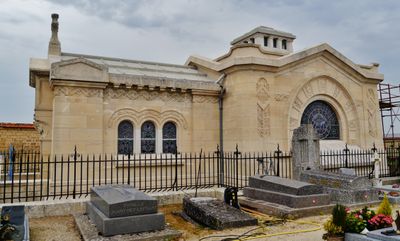
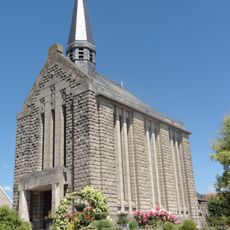
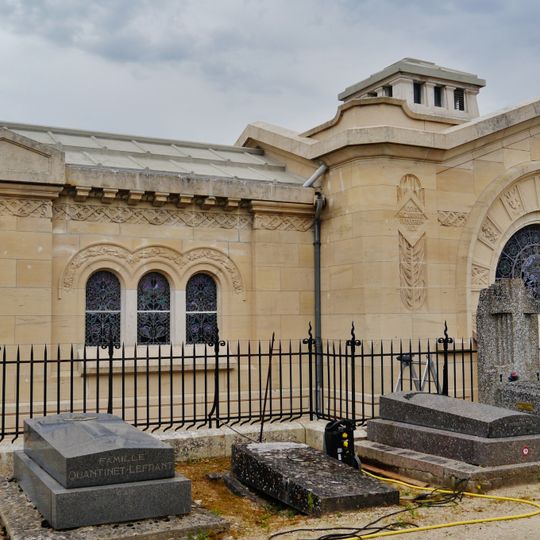
The Mausoleum of Bourgogne is a cruciform Byzantine-style tomb in the Bourgogne-Fresne cemetery, built of ashlar stone from the Mont Aimé quarries near Vertus. It measures about 18 meters long and 10 meters wide, with a hemispherical dome over the central crossing, a porch with a canopy, and a north-facing apse. The exterior is deliberately plain, with a floral frieze and a carved tympanum over the entrance.
The monument was built between 1898 and 1914 by Marie-Théodorine Zoé Promsy as a tribute to her late husband Jean-Marie Faynot, a magistrate. Construction followed his death in 1895, when his widow commissioned this elaborate structure to preserve his memory through architecture.
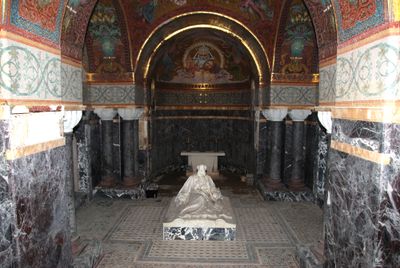
The interior decoration was made by Italian craftsmen, while Belgian artisans built the masonry. The mosaics, marble panels and central sculpture were commissioned from prestigious artists and workshops. The building was modelled on the 5th-century Mausoleum of Galla Placidia in Ravenna, a Byzantine reference chosen by the founder herself.
The mausoleum stands in the cemetery of Bourgogne, in the commune of Bourgogne-Fresne, in the Marne. It is oriented north-south, and a ditch surrounds it whose depth matches the interior floor of the central body. Access is through the porch, from which a staircase descends into the crypt.
The interior decoration was entrusted to Italian craftsmen while Belgian artisans built the masonry, and the stone matches that of Reims Cathedral, likely quarried at Mont Aimé near Vertus. The building was listed as a monument historique in 2020, then classified in 2025.
The community of curious travelers
AroundUs brings together thousands of curated places, local tips, and hidden gems, enriched daily by 93,956 contributors worldwide.