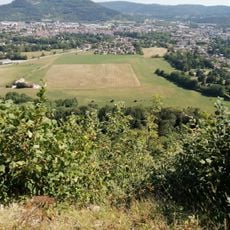
Mont Rivel, Limestone mountain summit in Jura, France
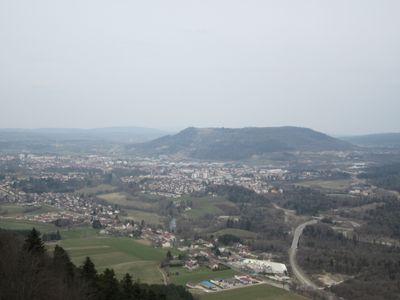
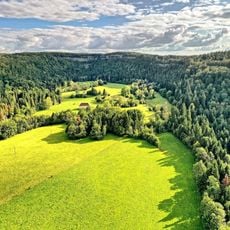
Mont Rivel is a limestone peak in the Jura region reaching about 812 meters in elevation. The summit displays the rocky formations typical of this mountain range's geology.
The summit's bar ridge was occupied in the Bronze Age, then used by Celts as a cult site, where a fanum-type temple was found and perhaps an oppidum. In the Gallo-Roman period an octagonal-plan temple likely preceded a vicus. In the Middle Ages a castle was built at 770 m on the bar ridge south of the summit plateau, and the seigneurie of Montrivel extended as far as Champagnole.
The name Montrivel comes from the medieval seigneurie of Montrivel, whose domain extended as far as Champagnole. Bronze Age occupation of the barred spur was followed by a Celtic place of worship, where a fanum-type temple was found, and possibly an oppidum. A Gallo-Roman octagonal temple probably preceded a vicus there.
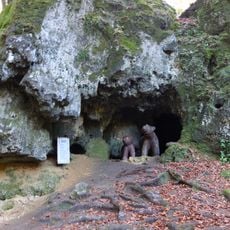
Mont Rivel rises above Champagnole, on the land of Équevillon near the Vannoz boundary; the summit plateau covers 30 ha and is reached from the town below. The Ain valley and the Champagnole plateau lie around it, so the climb gains height from the valley floor. The summit is a triangular, forested plateau, with a rocky face exposed on the left flank.
The summit's triangular plateau covers 30 hectares and is a butte-témoin over 160 million years old, left standing when glacial erosion wore away the surrounding Champagnole plateau. Its barred spur was occupied in the Bronze Age and later held a Celtic fanum temple.
The community of curious travelers
AroundUs brings together thousands of curated places, local tips, and hidden gems, enriched daily by 93,890 contributors worldwide.