Palais Bulles de Pierre Cardin

Log in to your account

AroundUs is a community-driven map of interesting places, built by curious explorers like you. It grows with every review, story, and photo you share.
Connect to save your favorite spots, contribute locations, and create personalized routes.
By continuing, you accept our Terms and Conditions and our Privacy Policy
Add to collection
Map
Suggest a change
Share

Palais Bulles de Pierre Cardin, Bubble-shaped residence in Théoule-sur-Mer, France

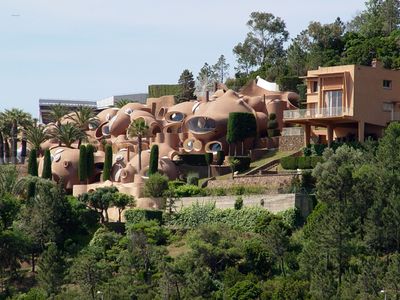
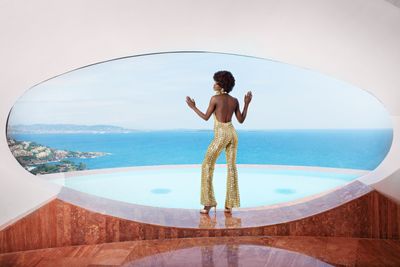
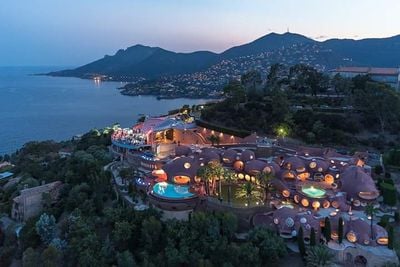
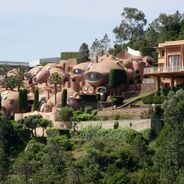
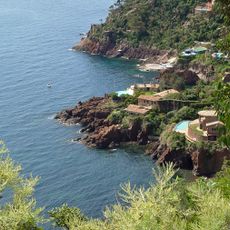
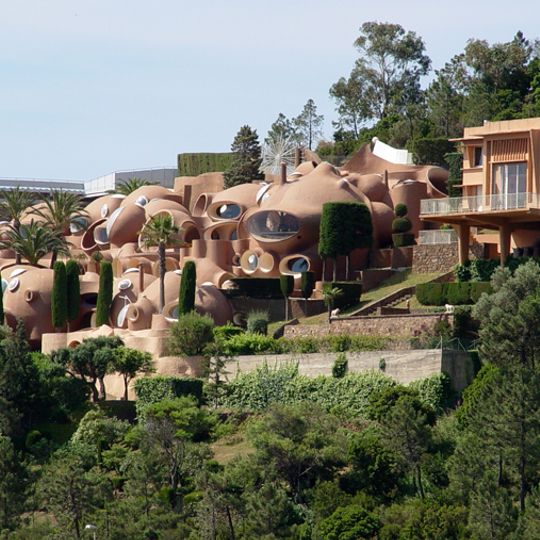
Palais Bulles de Pierre Cardin is a residence composed of interconnected dome structures in Théoule-sur-Mer on the French Riviera. The complex consists of 29 rooms with curved walls, multiple pools, and viewing terraces spread across a hillside site above the Mediterranean.

Finnish architect Antti Lovag designed the building between 1975 and 1989 for industrialist Pierre Bernard. Fashion designer Pierre Cardin acquired the property in 1992 and used it for fashion events and receptions along the coast.

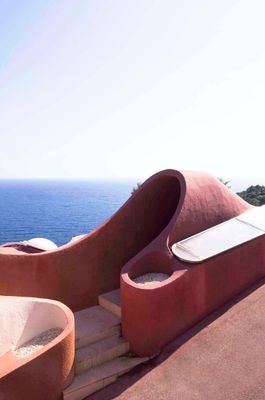
The interior follows a natural flow where each rounded chamber connects to the next without hallways or corners. Visitors move through the space along curved paths that open into sunlit domes and terraced platforms facing the water.

The property is available exclusively for private events and offers an amphitheater as well as reception spaces with sea views. Public tours are not offered, and the grounds remain private and accessible only through booked functions.

The entire structure avoids straight lines and uses only rounded forms that recall natural cell structures. The window panes were individually curved to fit the continuously vaulted building envelope.

Location: Théoule-sur-Mer

Architects: Antti Lovag

Address: Boulevard de l'Estérel, 06590 Théoule-sur-Mer

Website: https://palaisbulles.com

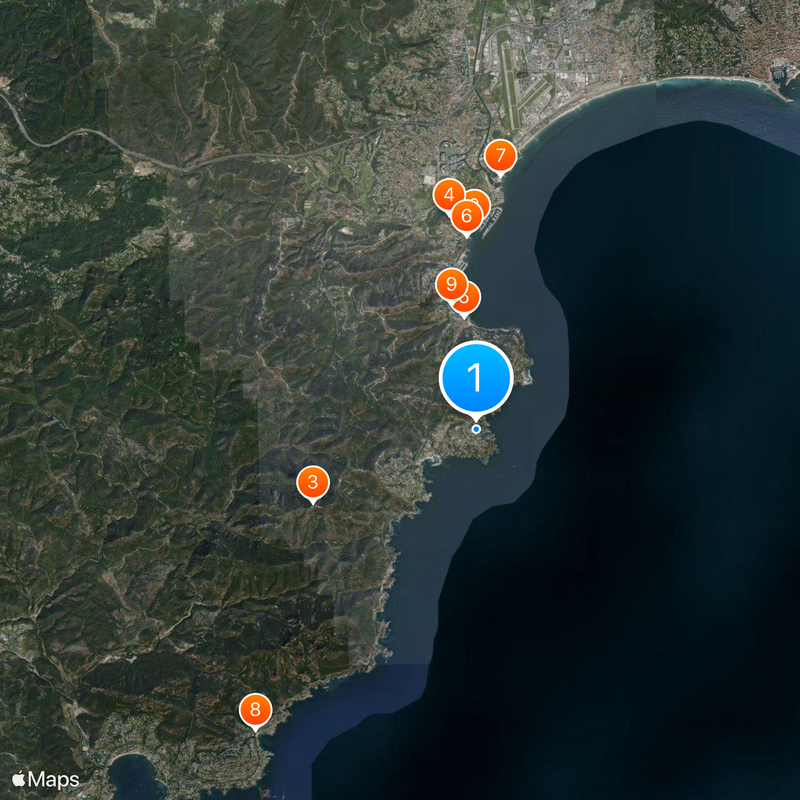
GPS coordinates: 43.48860,6.94363

Latest update: December 5, 2025 22:25

Architectural sites in Provence-Alpes-Côte d'Azur between Cistercian heritage and Mediterranean avant-gardes

The Provence-Alpes-Côte d'Azur region depicts a land where architecture narrates a thousand years of history between sea and mountains. From the 12th-century Cistercian abbeys to the brutalist experiments of Le Corbusier, this area features an exceptional built heritage shaped by Mediterranean light. You can find fortresses perched on rocky promontories, Romanesque monasteries where Van Gogh depicted his struggles, and contemporary museums that interact with the blue of the Mediterranean. Vineyards contain large-scale sculptures, the perched villages of Luberon display their medieval architecture in light stone, and Belle Époque villas in Cap d'Antibes mark the golden age of the Riviera. Between the limestone cliffs of the Calanques and the alpine valleys carved with prehistoric signs, Provençal architecture follows the contours of the land, capturing shadow and warmth, blending tradition and modernity. From the port of Marseille to the hanging gardens of Èze, each building bears the mark of a region where Cistercian builders, military engineers, visionary artists, and contemporary architects have inscribed their visions in stone, concrete, and landscape.

Photogenic places on the French Riviera: Between Monaco and Saint-Tropez

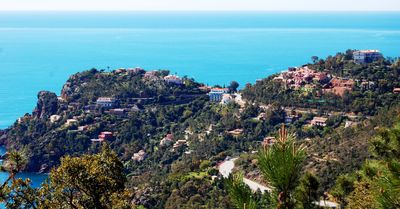
The French Riviera between Monaco and Saint-Tropez features a diverse architectural heritage reflecting centuries of history. Visitors can explore medieval villages such as the historic center of Grasse, known as the perfume capital since the 16th century, or Saint-Paul-de-Vence, home to the Maeght Foundation and its modern art collection. The region also has Belle Époque buildings like the Negresco Hotel in Nice, along with 20th-century architectural creations such as the Palais Bulles in Théoule-sur-Mer. Mediterranean gardens are another attraction along this coastal area. The Villa Ephrussi de Rothschild in Saint-Jean-Cap-Ferrat has nine themed gardens with vegetation suited to the local climate. The Bastide du Roy in Antibes preserves its geometric gardens and century-old olive trees. The coastline offers several vantage points overlooking the Mediterranean Sea, notably from the Le Corbusier Promenade connecting Cap Martin to Monaco over two miles, or from coves like Coco Beach where rocks and pebbles enable swimming and marine life observation.

Industrial architecture: transformation of historic sites, cultural centers, and public spaces

This collection gathers examples of architectural rehabilitation where former industrial sites have been transformed into new spaces for living, culture, and gatherings. These projects illustrate how contemporary architecture can give a second life to structures that marked European and North American industrial history, while maintaining their original identity. Included are the Oberhausen Gasometer, a 117-meter gas holder converted into exhibition space, the Van Nelle Factory in Rotterdam, an old coffee and tobacco factory turned cultural venue, and the High Line in New York, a 1930s elevated railway converted into a 2.3-kilometer urban park. The Zeche Zollverein complex in Essen showcases Bauhaus-style industrial architecture from the 1930s, while Strijp-S in Eindhoven, a former Philips production site, now hosts creative and technological studios. These sites demonstrate the possibilities offered by repurposing industrial heritage into accessible public spaces.

The most incredible structures in the world

Architecture does not have to follow straight lines and right angles. This collection presents buildings that stand out through their form: domes, spirals, tilted facades or organic structures that recall animals or plants. From Gaudí's mosaic covered works in Barcelona to the stacked concrete cubes of Habitat 67 in Montreal or the conical trulli of Alberobello, these structures demonstrate alternative approaches to construction. Some emerged from technical necessity, such as the temporary cardboard cathedral in Christchurch after the 2011 earthquake. Others are artistic statements: the Guggenheim Museum in Bilbao with its titanium plates, the Dancing House in Prague or the cubist houses in Rotterdam. In Đà Lạt, the Crazy House transforms tree trunks and caves into habitable spaces, while the Atomium in Brussels represents a magnified iron crystal. These structures attract visitors but also raise questions about function and livability. The Longaberger Basket Building in Ohio takes the form of a seven story basket. The Lotus Temple in New Delhi uses concrete shells to form 27 petals. The Aldar headquarters in Abu Dhabi resembles a circular coin. These buildings expand the definition of what architecture can be.

Reviews

Visited this place? Tap the stars to rate it and share your experience / photos with the community! Try now! You can cancel it anytime.

« Palais Bulles de Pierre Cardin - Bubble-shaped residence in Théoule-sur-Mer, France » is provided by Around Us (aroundus.com). Images and texts are derived from Wikimedia project under a Creative Commons license. You are allowed to copy, distribute, and modify copies of this page, under the conditions set by the license, as long as this note is clearly visible.

Discover hidden gems everywhere you go!

From secret cafés to breathtaking viewpoints, skip the crowded tourist spots and find places that match your style. Our app makes it easy with voice search, smart filtering, route optimization, and insider tips from travelers worldwide. Download now for the complete mobile experience.

Around Us App Screenshot

A unique approach to discovering new places

Le Figaro

All the places worth exploring

France Info

A tailor-made excursion in just a few clicks

20 Minutes