Palais de justice de Rouen, Gothic courthouse in central Rouen, France
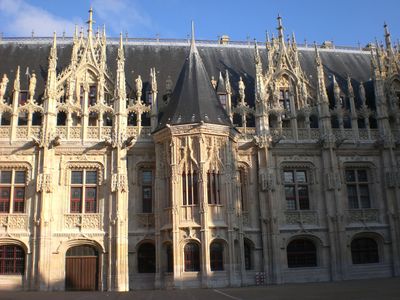
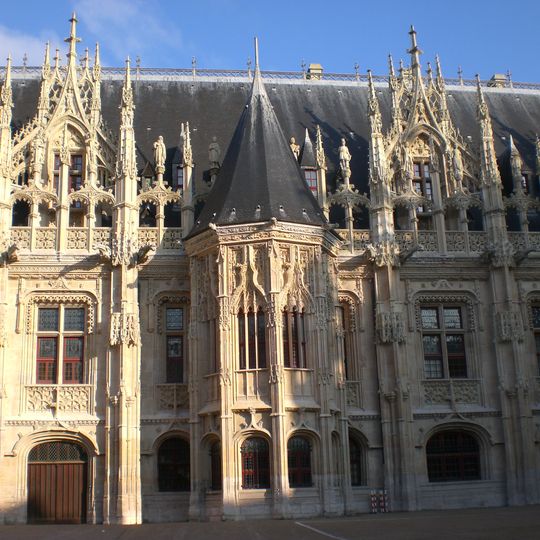
The Palais de justice de Rouen occupies a courtyard off the Rue aux Juifs, its pale beige stone facades built between 1499 and the 16th century. A polygonal turret with a tall slate spire projects from the central range, whose pointed-arched windows carry stone tracery and whose buttresses end in pinnacles. Carved figures stand in niches, and a low metal fence runs along the base.
Construction took place between 1499 and 1507, initially serving as the seat of the Échiquier de Normandie. In 1515 it became the seat of the Parliament of Normandy under King François I.
The Maison Sublime, a medieval yeshiva, was found beneath the right-hand steps of the courtyard, not under the east wing. Its low surviving walls carry a Hebrew inscription, "May this house be sublime!", and a carved lion of Judah. Rashbam, grandson of Rachi de Troyes, and Abraham ibn Ezra taught here; the 1306 expulsion of the Jews from France ended its activity.
The building is located on Rue aux Juifs and still functions as an active courthouse, so visits are possible but during limited times. Plan your visit in advance since parts of the building may not be open to the public when legal proceedings are underway.
The Maison Sublime, a medieval rabbinical school, survives beneath the courtyard of honour, reached by the right-hand staircase. Its low walls carry a Hebrew inscription, "May this house be sublime!", and a carved lion of Judah. It was rediscovered in 1976 during work in the courtyard.
The community of curious travelers
AroundUs brings together thousands of curated places, local tips, and hidden gems, enriched daily by 92,807 contributors worldwide.