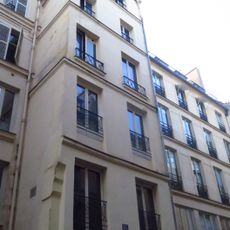
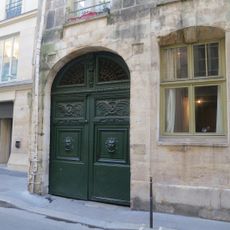
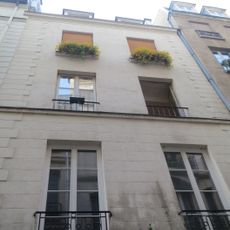
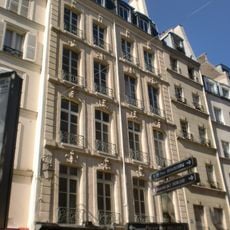
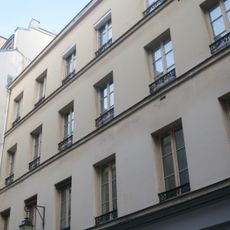
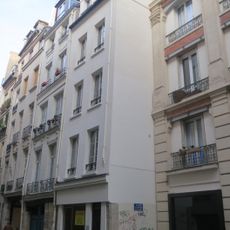
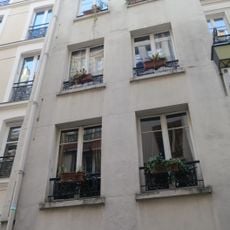
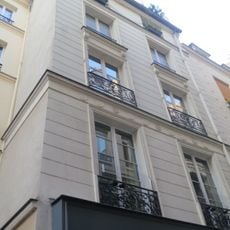
Passage Molière, Historic passageway in 3rd arrondissement of Paris, France.
Passage Molière is a pedestrian passageway in the 3rd arrondissement of Paris, running east-west for 46 metres and 2.75 metres wide between 157 rue Saint-Martin and 82 rue Quincampoix. It begins at each end with a porch and is open to the sky except where it passes under the buildings. Its paving slopes slightly to form a gutter down the middle.
Opened around 1791, the passage was named after the Théâtre Molière, built nearby in two months that year by actor Jean-François Boursault-Malherbe. An imperial decree of 8 August 1807 limiting the number of Paris theatres forced it to close; in the 19th century the hall served as a ballroom. The passage was called passage des Sans-Culottes under the Revolution and passage des Nourrices, and was inscribed as a monument historique in 1984.
The name comes from the Molière theatre built nearby in 1791 by actor Jean-François Boursault-Malherbe, whose hall hosted English, German and Spanish plays until an 1807 imperial decree closed it. In the 19th century the hall served as a ballroom. Since 2022 the Maison de la Poésie, a literary stage, occupies the corner with rue Saint-Martin.
Passage Molière runs 46 m east–west between 157 rue Saint-Martin and 82 rue Quincampoix, perpendicular to both. It is open to the sky except where it passes under the buildings at each end, so the two porches are the only sheltered parts. The paving slopes slightly toward a channel down the middle. Métro Rambuteau (line 11) is 200 m east, Étienne Marcel (line 4) 200 m northwest.
The numbering runs counter-clockwise: it starts on the right side at the rue Saint-Martin entrance, climbs westward, then resumes from the western end on the other side and works back east. The passage also bore two other names, passage des Sans-Culottes during the Revolution and passage des Nourrices.
The community of curious travelers
AroundUs brings together thousands of curated places, local tips, and hidden gems, enriched daily by 93,103 contributors worldwide.