Uzès Cathedral organ, Pipe organ at Saint-Théodorit Cathedral, Uzès, France
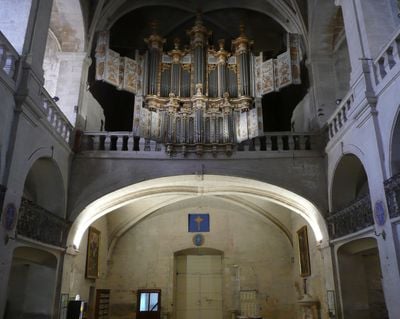
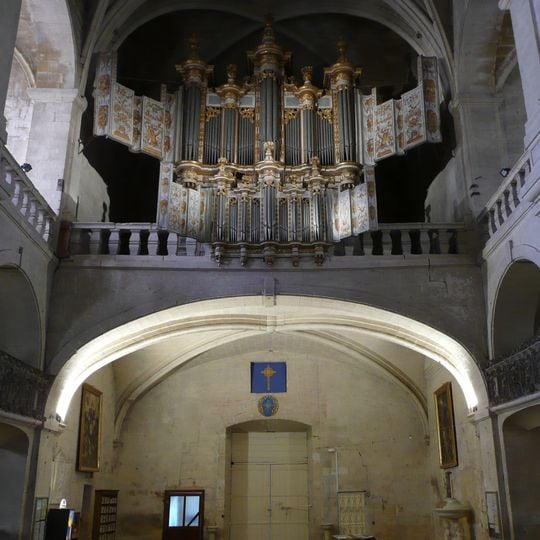
The Daublaine and Callinet organ at Saint-Théodorit Cathedral in Uzès is a large mechanical instrument made up of hundreds of pipes arranged in different sections. The organist controls these pipes through a keyboard and stop levers to produce the various sounds and tones needed for performances.
The first organ was built in 1679 by Father Castie, a Capuchin organ builder, and its Louis XIV buffet was carved by Pierre Biscarrat of Pont-Saint-Esprit, then painted and gilded in 1685 by Jean Pouville of Montpellier. The pipework was rebuilt around 1770 by an unknown builder, then reconstructed in 1843 by Daublaine & Callinet, who added romantic stops and enlarged the pedalboard. Classified as a monument historique in 1934, it was restored in 1964 by Alfred Kern, who kept the 17th- and 18th-century stops and removed the 19th-century romantic ones.
The organ is played during religious services and public concerts within the cathedral, reflecting musical traditions that developed over many generations. Visitors can hear how different stops and pipes create sounds that were important to church life and community celebrations.
The organ can be heard during regular church services and special concert events held in the cathedral throughout the year. The best time to visit is during these musical performances when the instrument is being played.
The painted shutters on the case are original: canvases stretched on hinged frames that once hid the pipes outside services and during Lent or Advent, a medieval practice. Only one other gilded case survives in France, at Saint-Louis des Invalides in Paris, and it is far heavier.
The community of curious travelers
AroundUs brings together thousands of curated places, local tips, and hidden gems, enriched daily by 94,665 contributors worldwide.