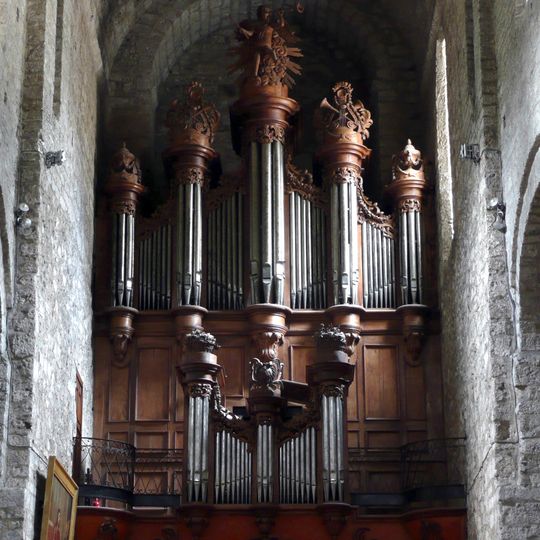
Pipe organ in Saint-Guilhem-le-Désert abbey church, Historical pipe organ in Gellone Abbey church, Saint-Guilhem-le-Désert, France.
The organ of Gellone Abbey has a two-part walnut case with lime-wood carvings and rocaille openwork; the carvers are unknown. The grand corps forms a five-turret mitre with four flat faces, while the rear positive is V-shaped with three turrets and two flat faces. The photograph shows five sections of silver metal pipes, the three central ones taller, crowned by carved wooden figures, with carved brackets below and a dark metal railing in front.
Jean-Pierre Cavaillé, grandfather of Aristide Cavaillé-Coll, built the organ from 1782 to 1789 with 27 stops on three keyboards and a pedalboard. The Revolution left it playable but without the rear positive's pipes. Organist J. Laffond saved it in 1792 by playing revolutionary tunes during the seizure, and in 1804 by substituting Saint-Thibéry's name for Saint-Guilhem's. Classified in 1974, the rear positive was completed in 1984.
The instrument sounds during religious services and concerts inside the abbey church, shaping how visitors experience the sacred space. It remains tied to the spiritual life of the community and the musical traditions of the region.
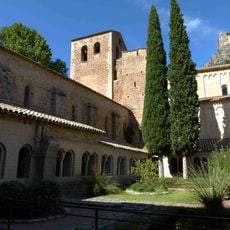
The organ stands on the tribune above the entrance of the former abbey church, now the parish church of Saint-Guilhem-le-Désert. Visitors look up at the case from the nave; the console and keyboards are not at floor level. The German text wrongly places access outside the church.
This organ is one of the few works by Cavaillé that still has all its original mechanical components from the 18th century intact. Such complete preservation is remarkably rare for instruments of this age.
The community of curious travelers
AroundUs brings together thousands of curated places, local tips, and hidden gems, enriched daily by 93,130 contributors worldwide.