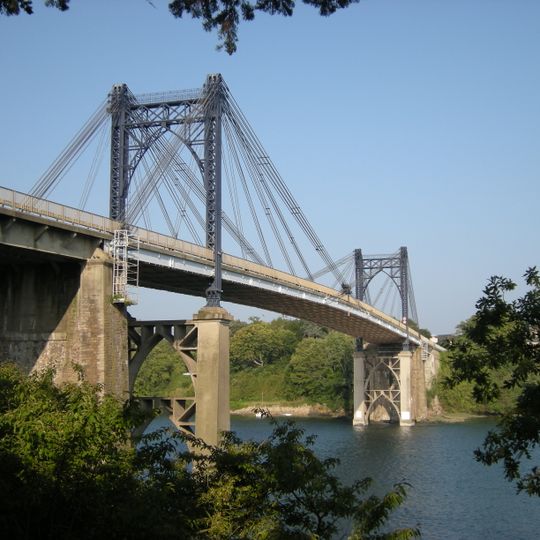
Pont de Lézardrieux, Cable-stayed road bridge in Lézardrieux, France
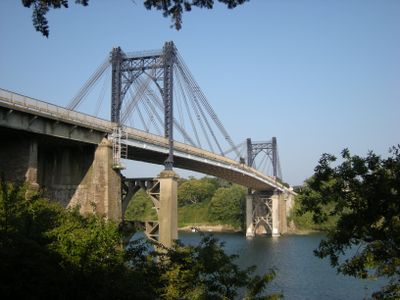
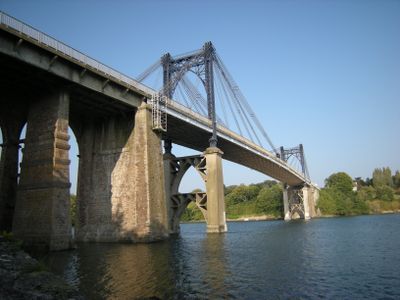
The Pont de Lézardrieux carries the D 786 road over the Trieux on a Gisclard-type cable-stayed deck. Its main span is 112 m, held by steel cables fanning from two metal towers that stand on the surviving masonry piers of the 1840 suspension bridge. Grey stone blocks rise from the water, and below the deck open steel arches frame the approach ramps.
Marc Seguin obtained the concession in 1836 and opened a suspension bridge with masonry pylons on 10 August 1840; it was a toll bridge until 1866. Ferdinand Arnodin renewed the deck between 1882 and 1889. From 1922 to 1925 Gaston Leinekugel Le Cocq rebuilt it as a Gisclard cable-stayed bridge carrying a metre-gauge railway and two road lanes; the line closed in 1950.
Before the bridge, travellers crossed the Trieux by ferry; boatmen and the town of Pontrieux fought the 1836 concession granted to Marc Seguin. The structure carried the metre-gauge Paimpol–Tréguier railway until the line closed in 1950, when the rails were lifted and two asphalt lanes and a narrow footway installed.
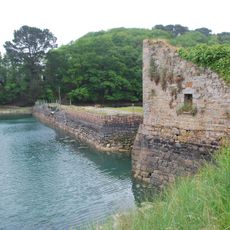
The bridge carries the D786 road over the Trieux, whose strong tidal current cuts a deep channel; it links Paimpol and Lézardrieux with Tréguier and Lannion. Since the railway closed in 1950 the deck has held two asphalted lanes and a narrow footway, so walkers cross beside traffic. The massive pier bases and the masonry ramp arches survive from the 1840 bridge.
The 1925 Gisclard system anchors its cables in the opposite half of the deck, so they cross and form a knot just above the roadway at mid-span. The old masonry pylons were demolished, leaving only their massive bases and the ramp arches, later replaced by steel beams.
The community of curious travelers
AroundUs brings together thousands of curated places, local tips, and hidden gems, enriched daily by 94,045 contributors worldwide.