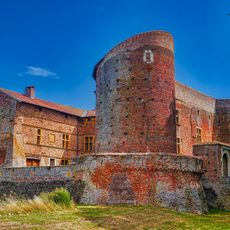
Poype de Villars-les-Dombes, Medieval motte-and-bailey castle in Villars-les-Dombes, France.
Poype de Villars-les-Dombes is an artificial mound at the centre of Villars-les-Dombes, topped by the remains of a round tower of red brick dated to around 940. The mound rises behind a low wire fence and a wooden picket fence, covered with bare trees and dry brown leaf litter, with patches of green ivy on its left side. Near the base, to the right of centre, stands a small rectangular shelter with a flat red roof, its walls partly covered in ivy.
This fortification originated in the 10th century as both a defensive structure and residence for local nobility. Partial destruction in 1595 marked a turning point that altered its physical form and purpose.
The mound gave its name to a lordship that rose through the ranks: seigneurie, then barony in 1432, county in 1565 and finally marquisate. The village church, which keeps Romanesque remains, stood at the centre of the settlement while the motte lay on its edge. Three other mottes once stood in the commune: Filioli, destroyed around 1847, la Juyre and Termant.
The mound stands in the centre of Villars-les-Dombes, with the remains of the round brick tower at its top; the earthwork is reached on foot from the surrounding streets. The slope is steep and covered with trees and leaf litter, and the summit is hidden by trunks and branches, so wear shoes with good grip. A low wire fence and a wooden picket fence run along the base.
Excavations from 1988 revealed a complete Romanesque church buried inside the mound, probably from the 11th century. Below its apse, archaeologists found a square tower with a barrel-vaulted ceiling, dated by carbon-14 to the 10th century and built partly with reused Gallo-Roman blocks.
The community of curious travelers
AroundUs brings together thousands of curated places, local tips, and hidden gems, enriched daily by 94,659 contributors worldwide.