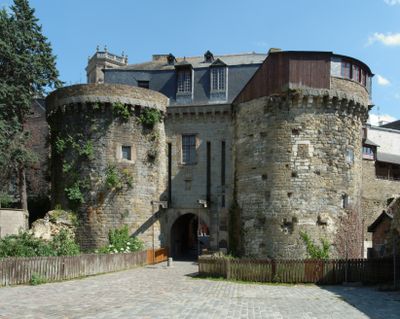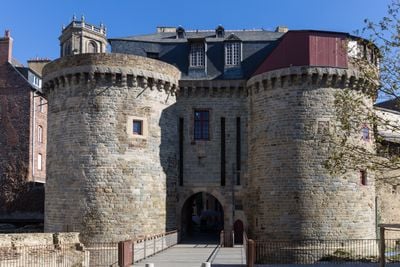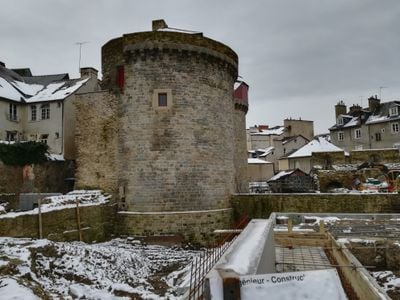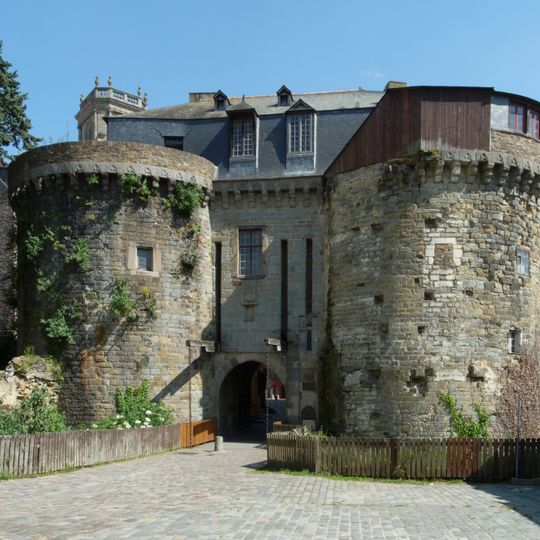
Porte Mordelaise, Medieval city gate in Rennes, France.
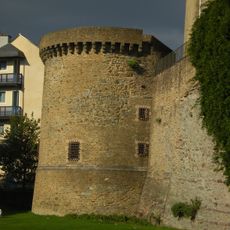
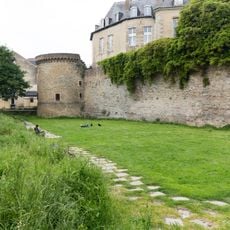
The Porte Mordelaise is a fortified gateway in Rennes featuring two stone towers that frame a central passage as a remaining element of the city's medieval defenses. The structure shows the practical design of 15th-century military architecture with solid masonry and controlled access points.
The site has held a gate since Rennes' first ramparts were built in the 3rd century, though the present structure is mainly 15th-century. From 1418 it was repeatedly renovated to house the city's governors, serving that role until the late 16th century, then used for meetings of the town community. It was leased out in 1723 in poor condition, became a prison named "porte Marat" in 1793, and was inscribed as a monument historique on 11 June 1926.
The name comes from Mordelles, an important fief from the 11th century toward which this entrance led. Future dukes had to swear an oath before the gate, which earned it the names porte royale, porte ducale and porte épiscopale. Above the carriage arch is a carved stone blazon: two lions on either side of a lance, the arms of the Montfort dukes who ruled Brittany from 1364 to 1514.
The gate sits in the heart of Rennes' old town at the intersection of Rue des Portes Mordelaises and Rue de Dinan, within easy walking distance of other historic sites. The surrounding area provides space to view the towers from multiple angles and to understand the gate's relationship to the surrounding streets.
A granite block built into the gate was a Roman votive stele from the 3rd century, dedicated to Emperor Gordian III and set upside down as ordinary masonry. Stendhal noted it in 1838 in Mémoires d'un touriste; in 1874 it was removed and given to the Musée de Bretagne, where it is kept in storage.
The community of curious travelers
AroundUs brings together thousands of curated places, local tips, and hidden gems, enriched daily by 92,899 contributors worldwide.